
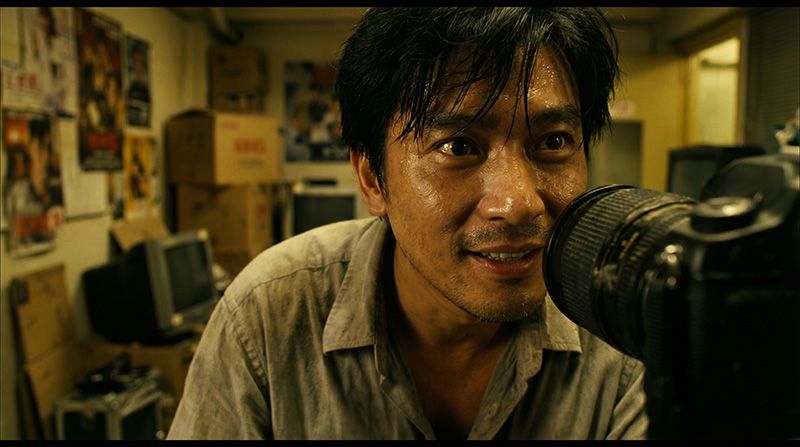
The Most Depraved Category III Film Ever Made
Ebola Syndrome (1996) stands as one of the most notorious and boundary-pushing films in Hong Kong cinema history. Director Herman Yau and star Anthony Wong, fresh from their collaboration on The Untold Story, created a film that doesn’t just flirt with bad taste — it revels in it with unapologetic, manic glee. This is not a conventional horror film. It is a grotesque, pitch-black exploitation fever dream that uses the real-world terror of the Ebola virus as the backdrop for one of the most irredeemable protagonists ever put on screen.
Anthony Wong delivers a performance of pure chaotic evil as Kai San — a racist, misogynistic, violent fugitive who becomes a walking biological weapon after contracting Ebola in South Africa. Instead of succumbing to the disease, he discovers he is immune and highly contagious. Rather than warn anyone, he weaponizes his infection, spreading the virus through spit, blood, semen, and contaminated meat with sadistic delight.
💎 Verified Fact: Anthony Wong has repeatedly said in interviews that he treated Ebola Syndrome as a pitch-black comedy. Because the production was rushed and chaotic (filmed on location in post-apartheid South Africa), he improvised the majority of his most unhinged and offensive dialogue on the spot. His goal was to make Kai San so cartoonishly vile that the audience would be forced to laugh at the sheer absurdity of his depravity. The film was shot in just 18 days, yet the practical effects and Wong’s physical performance remain disturbingly effective decades later.
A Transgressive Viral Nightmare
Released at a time when real Ebola outbreaks dominated international news, Herman Yau took global fear and dragged it through the filthiest corners of exploitation cinema. The film is deliberately repulsive — full of graphic bodily fluids, sexual violence, and dark humor that makes no attempt to redeem its protagonist. It functions as both a sick joke on pandemic panic and a spiritual successor to the most extreme Hong Kong Category III films of the 90s.
While undeniably offensive by modern standards, Ebola Syndrome remains a fascinating artifact of an era when Asian cinema was willing to go further than almost anyone else. It is ugly, chaotic, and completely without restraint — and that is exactly why it endures as a cult classic among fans of extreme cinema.
Frequently Asked Questions About Ebola Syndrome (1996)
What is Ebola Syndrome (1996) about?
A violent fugitive contracts Ebola in South Africa but becomes an asymptomatic super-spreader. He returns to Hong Kong and deliberately infects people using his bodily fluids and contaminated food in this extremely graphic and transgressive Category III film.
Is Ebola Syndrome a sequel to The Untold Story?
Not a direct sequel, but it is widely regarded as a spiritual successor. Both films were directed by Herman Yau, star Anthony Wong as a depraved and violent restaurant worker, and represent the peak of Hong Kong’s notorious Category III extreme cinema.
Why is Ebola Syndrome considered so extreme?
The film contains graphic depictions of sexual violence, bodily fluids, disease spread, and pitch-black humor. It was made specifically to shock and provoke adult audiences during the golden age of Hong Kong Category III exploitation.
Who is the main actor in Ebola Syndrome?
Anthony Wong Chau-sang delivers one of his most unhinged performances as Kai San, a completely irredeemable and chaotic protagonist. His manic, physically committed acting is central to the film’s disturbing power.
Who directed Ebola Syndrome (1996)?
Ebola Syndrome was directed by Herman Yau, known for his work in controversial, gritty, and boundary-pushing films within Hong Kong cinema.