
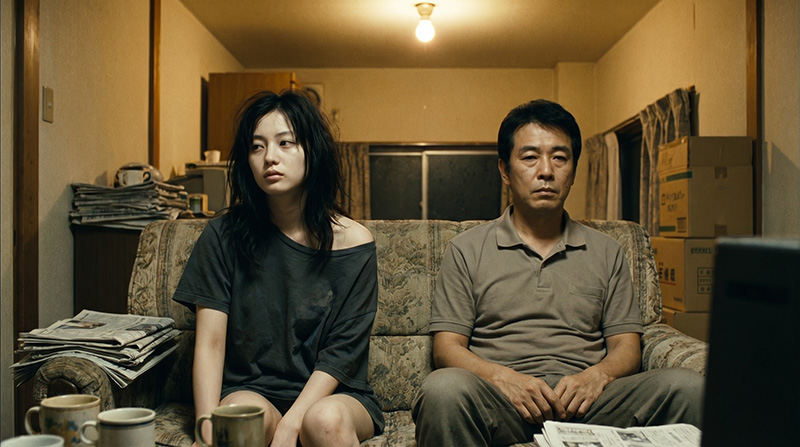
Takashi Miike’s Most Transgressive Masterpiece
Visitor Q (2001) stands as one of the most shocking, philosophically dense, and stylistically audacious films in Takashi Miike’s legendary filmography. Released in the same year as Ichi the Killer, this micro-budget DV experiment takes the concept of family dysfunction and pushes it into truly grotesque, surreal, and often hilarious territory. What begins as an unrelenting assault on the senses slowly reveals itself as a bizarre satire on the collapse — and perverse reconstruction — of the modern Japanese family.
The Yamazaki family is already in a state of terminal decay. The father is a failed television reporter who films himself having sex with his own daughter for a documentary. The son is brutally bullied at school and takes out his rage by beating his heroin-addicted mother. Into this rotting domestic nightmare walks Visitor Q — a silent, enigmatic, and disturbingly calm stranger who communicates primarily by smashing people over the head with a rock. What follows is a chaotic, taboo-shattering journey that blends necrophilia, lactation, murder, incest, and black comedy into something strangely transcendent.
💎 Verified Fact: Takashi Miike shot Visitor Q in just six days on a budget of approximately $70,000 as part of the experimental “Love Cinema” direct-to-video series. The grainy, handheld DV aesthetic was a deliberate choice to create an uncomfortably voyeuristic, almost snuff-like atmosphere. Despite (or because of) its extreme content — including incest, necrophilia, graphic lactation, and murder — the film was invited to screen at the Venice Film Festival the same year as Ichi the Killer.
A Grotesque Answer to Pasolini’s Teorema
Critics frequently cite Visitor Q as a perverse, satirical response to Pier Paolo Pasolini’s 1968 film Teorema. In Pasolini’s work, a mysterious stranger brings spiritual awakening to a bourgeois family. Miike takes the same premise and drags it through the filthiest possible mud. Instead of enlightenment, Visitor Q brings violence, perversion, and chaotic rebirth. The film suggests that the only way this broken family can be “healed” is through even greater extremes of depravity.
The recurring motif of breast milk — culminating in the mother’s surreal, almost biblical lactation — becomes a strange symbol of perverse nourishment and family reconciliation. By the end, the family is smiling, united, and protective of one another. The fact that this unity was achieved through murder, mutilation, and taboo is the ultimate dark punchline of Miike’s twisted comedy.
Frequently Asked Questions About Visitor Q (2001)
What is Visitor Q (2001) about?
A deeply dysfunctional Japanese family — marked by incest, domestic violence, drug addiction, and bullying — undergoes a bizarre and grotesque transformation when a mysterious, violent stranger known as Visitor Q enters their lives.
Is Visitor Q a horror film or a black comedy?
It is fundamentally a pitch-black comedy that uses extreme transgressive horror elements (incest, necrophilia, violence, lactation) as satirical tools to deconstruct the collapse of the modern Japanese family.
Why does Visitor Q look like a low-budget home video?
The grainy, handheld DV aesthetic was completely intentional. The film was part of the 'Love Cinema' series, shot in just six days on a micro-budget of around $70,000 to create an uncomfortably intimate, voyeuristic, almost snuff-like atmosphere.
How is Visitor Q connected to Pasolini’s Teorema?
Visitor Q is widely regarded as a grotesque, satirical response to Pier Paolo Pasolini’s 1968 film Teorema. Where Pasolini’s stranger brings spiritual awakening, Miike’s Visitor Q brings violence, perversion, and chaotic rebirth.
Why is Visitor Q (2001) considered one of Takashi Miike’s most extreme films?
The film pushes boundaries with taboo subjects, graphic content, and absurd dark humor, using shock not just for provocation but as a critique of family breakdown and societal decay.