
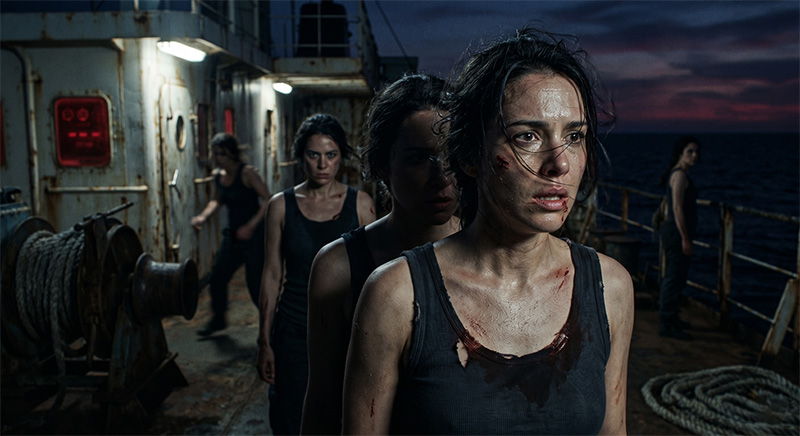
A Nightmare of Eternal Recurrence
Christopher Smith’s Triangle (2009) stands as one of the most intelligent and devastating psychological horror films of the 21st century. On the surface it appears to be a survival story aboard a haunted ocean liner. In reality, it is a merciless examination of guilt, denial, and the inescapable consequences of our choices. The film uses the mechanics of a time loop not as a gimmick, but as a philosophical trap that forces its protagonist — and the audience — to witness the same tragedy unfold with increasing horror.
The genius of the film lies in how methodically it reveals its rules. What begins as confusion slowly transforms into dreadful understanding. Every death, every act of violence, every desperate attempt to break the cycle only tightens the noose. Melissa George delivers a raw, physically demanding performance that carries the entire weight of this temporal nightmare.
Mythology and Maternal Guilt
The film draws deeply from the Greek myth of Sisyphus, condemning its central character to repeat an eternity of violence because she cannot accept a terrible loss. The abandoned ship named Aeolus serves as both setting and metaphor. What makes Triangle particularly effective is that it never offers easy catharsis. The loop is not broken by heroism or revelation — it is sustained by the protagonist’s own inability to let go.
💎 Verified Fact: The production team built a massive practical set of the ocean liner’s deck on a barge in the open ocean off the coast of Queensland, Australia. The camera rig had to withstand extreme weather conditions that repeatedly threatened to destroy the equipment. Melissa George performed almost all of her own stunts, including several sequences that left her genuinely bruised and exhausted by the end of filming. The film’s complex timeline was mapped out on a 30-foot whiteboard before shooting began.
Frequently Asked Questions About Triangle (2009)
What is the deeper meaning behind Triangle (2009)?
The film serves as a modern horror retelling of the Greek myth of Sisyphus. Jess is trapped in an endless cycle of violence and guilt, unable to escape because she cannot accept the death of her autistic son and the broken promise she made.
Why is the abandoned ship named Aeolus?
In Greek mythology, Aeolus was the father of Sisyphus. The name is a deliberate clue that foreshadows the film’s central theme of eternal, futile repetition.
How many versions of Jess exist on the ship simultaneously?
During the second half of the film, there are typically three distinct versions of Jess active at the same time: the confused newcomer, the masked killer, and the desperate woman attempting to break the cycle.
Is Triangle (2009) based on a true story or myth?
While entirely fictional, the story draws heavily from the Greek myth of Sisyphus, who was punished by the gods with the eternal task of pushing a boulder uphill only for it to roll back down forever.
Who directed Triangle (2009)?
Triangle was directed by Christopher Smith, known for blending horror, thriller, and high-concept storytelling.