
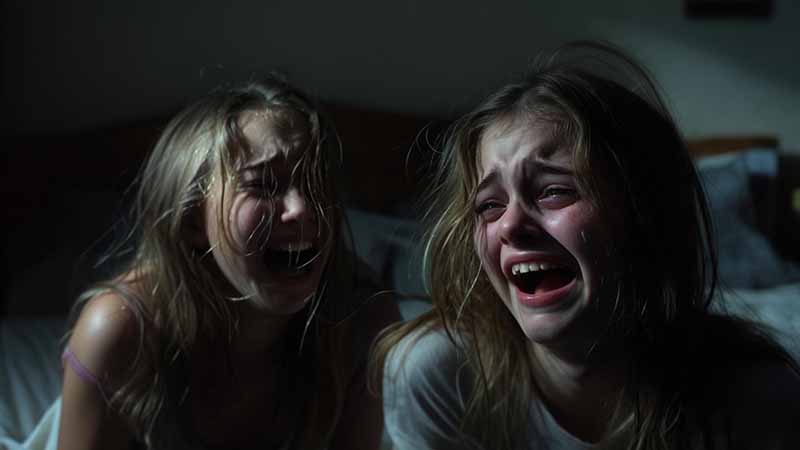
Thirteen (2003): Catherine Hardwicke's Unflinching Portrait of Adolescent Collapse
Thirteen does not arrive gently. It opens mid-deterioration and never steps back to offer comfort or perspective. Directed by Catherine Hardwicke in her feature debut and co-written by Nikki Reed, who was thirteen years old when she put the script together, the film follows Tracy — a straight-A student in Los Angeles who crosses paths with Evie, the most dangerous girl in her school, and begins an accelerating descent into drugs, shoplifting, self-harm, and emotional disintegration. What makes Thirteen genuinely difficult to watch is not the content in isolation but the specific recognition it produces: this is not exploitation, not cautionary-tale artifice, and not moral panic dressed as drama. It is observation. It is memory. It is a girl writing down what happened to her before she was old enough to fully understand it.
Hardwicke shoots the film with a restless, documentary-adjacent visual grammar — handheld, close, frequently overexposed in the Los Angeles sun as if the camera itself is overwhelmed by the brightness and noise of adolescent life. The aesthetic mirrors Tracy's experience of Evie: electric, intoxicating, and deeply unstable. As the film progresses and Tracy's world contracts into compulsive behavior and isolation, the visual palette follows her — darker, more interior, more claustrophobic. This is formal storytelling in service of psychological realism, not stylization for its own sake. Hardwicke, who had previously worked as a production designer, understands environment as psychology. Every space in the film is an argument about the character who inhabits it.
Nikki Reed at Thirteen — The Autobiographical Script That Became a Film
The origin of Thirteen is inseparable from its power. Nikki Reed, who had been living with director Catherine Hardwicke during a troubled period in her own adolescence, wrote the first draft of the screenplay in six days at the age of thirteen. The material was drawn directly from her own experiences — the friendships, the peer pressure, the substance use, the self-harm, the feeling of identity dissolving under the weight of social performance. Hardwicke recognized the rawness of the material immediately and worked with Reed to shape it into a functional screenplay, preserving as much of the original voice and specificity as possible.
That specificity is what separates Thirteen from the many American films that have attempted to dramatize teenage self-destruction from the outside. Reed was not writing a warning. She was writing a record — vivid, unguarded, and occasionally incoherent in the way that lived experience always is. The scenes that most disturb audiences tend to be the smallest: the rituals of self-harm conducted almost casually, the shoplifting that feels like sport, the pharmaceutical experiments treated with the same emotional register as any other afternoon activity. These are not the behaviors of delinquents as cinema normally imagines them. They are the behaviors of children who have found a grammar for pain that the adults around them cannot read.
Evan Rachel Wood, Holly Hunter, and the Performance Architecture of Trauma
Evan Rachel Wood, who was fifteen when production began, delivered one of the most technically demanding and emotionally unprotected debut lead performances in American independent cinema. Tracy's arc moves from competence to chaos over the film's hundred minutes, and Wood plays every transition with precise attention to what is being lost and what is being displaced. There is no sentimentality in her work, no invitation to pity. Tracy is difficult throughout — hungry, volatile, sometimes cruel — and Wood never softens that difficulty. The result is a character who remains recognizable and specific rather than becoming a symbol of something larger than herself.
Holly Hunter's performance as Melanie, Tracy's recovering-addict mother, earned her an Academy Award nomination for Best Supporting Actress and a Screen Actors Guild Award. Hunter plays Melanie without defensive irony — the character is warm, flawed, frightened, and often simply outpaced by events she does not know how to read. The dynamic between Hunter and Wood is the film's structural spine: a love relationship that is genuine and strained by the exact pressures that make it most necessary. Melanie wants to reach Tracy and cannot find the right language. Tracy wants her mother to reach her and cannot ask for that directly. The space between them is where the film lives.
Catherine Hardwicke and the Grammar of First Features
What is remarkable about Thirteen as a directorial debut is that Hardwicke was already fifty years old when she made it, having spent two decades as a production designer on films including Singles and Three Kings. Her background is entirely visible in the visual intelligence of the film and entirely absent from any sense of artistic caution. Thirteen was shot on a budget of approximately two million dollars in roughly three weeks, with Hardwicke pulling performances from her young cast through rehearsal processes that blurred the boundary between improvisation and scripted material. The film premiered at the Sundance Film Festival in January 2003 and won the Special Jury Prize for Dramatic Directing — a recognition of exactly the quality that makes it still essential: the conviction that form and content are the same thing, and that neither can afford to lie.
💎 Verified Fact: Nikki Reed wrote the original script for Thirteen in six days at age thirteen while living with director Catherine Hardwicke, who had taken Reed in during a turbulent period in the teenager's home life. Reed originally intended to write the screenplay under a pseudonym because the autobiographical content was so specific that she feared the reaction of people who would recognize themselves in it. Hardwicke persuaded her to use her real name, arguing that the film's authenticity depended on the audience understanding that the material came from inside, not from observation. Reed then chose to perform the role of Evie — the character based most directly on the friend who had pulled her into self-destruction — rather than the Tracy role, which maps more closely onto her own experience. That inversion gives her performance a particular tension that runs underneath every scene she appears in.
Frequently Asked Questions About Thirteen (2003)
Where can I access Thirteen (2003)?
Sharing The Sickness provides an external player reference for this title through an independent third-party platform. We do not host or store media files on this page.
What is Thirteen (2003) about?
Thirteen (2003) follows a young girl whose life spirals into rebellion, substance use, and emotional instability after she becomes entangled with a manipulative and influential friend, leading to a rapid loss of identity and control.
Why is Thirteen (2003) considered disturbing?
Thirteen (2003) is considered disturbing because of its raw and realistic portrayal of teenage self-destruction, including drug use, self-harm, emotional volatility, and the rapid collapse of innocence under peer pressure.
Who directed Thirteen (2003)?
Thirteen (2003) was directed by Catherine Hardwicke.
Was Thirteen (2003) controversial or censored?
Thirteen (2003) generated significant controversy due to its explicit depiction of adolescent behavior and self-destructive themes, leading to strict age classifications in many countries rather than outright bans.