
Starry Eyes (2014): Hollywood as Satanic Pact — Ambition, Body Horror, and the Price of the Dream
Starry Eyes understands something that most Hollywood satires only gesture at: the system is not merely corrupt — it is occult. It runs on sacrifice. It demands that you offer something of yourself that you cannot get back, and the transaction is conducted in rooms where the power differential is so total that the word choice becomes almost meaningless. Written and directed by Kevin Kölsch and Dennis Widmyer as their feature debut, the film follows Sarah — a young actress working a humiliating job at a fast food chain called Taters while grinding through auditions that lead nowhere — until one leads somewhere she cannot return from. The production company is called Astraeus Pictures. The casting director has a pentagram necklace. The audition process asks progressively more of Sarah's body. The film makes its metaphor explicit and then keeps going past the point where metaphor ends and body horror begins.
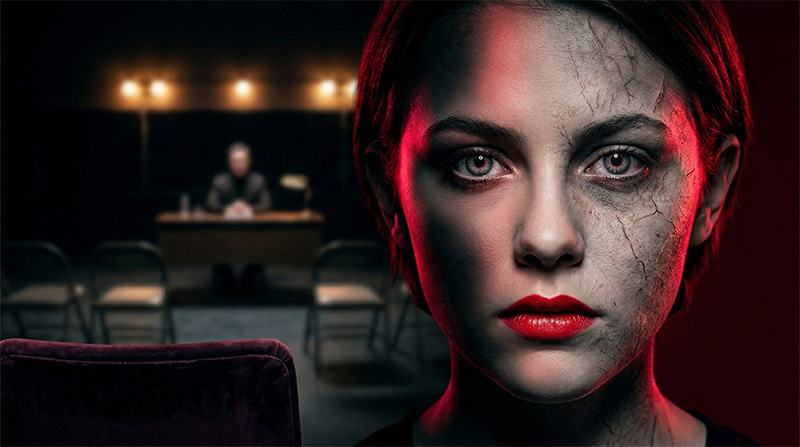
The first two acts of Starry Eyes operate as precise social observation. Sarah's world is populated by friends who undermine her, a workplace that degrades her, and an industry that uses her desperation as leverage. Kölsch and Widmyer shoot this milieu with the flat, airless visual grammar of late-night Los Angeles — strip malls, pool parties, apartment corridors that go nowhere. The contrast with the Astraeus audition rooms — dark, formally composed, lit like a stage — signals immediately that Sarah has stepped into a different register of reality. When the film shifts into its third act, the transformation is literal: hair falling out, nails peeling, the body becoming something else entirely. The horror is not metaphorical anymore. It is happening to the flesh.
Alexandra Essoe's Breakthrough and the FANGORIA Chainsaw Award
Alexandra Essoe's performance as Sarah is the film's central achievement and its critical anchor. Essoe was a largely unknown actress when Kölsch and Widmyer cast her, and the role required sustained commitment across three radically different registers: the fraying competence of Sarah's ordinary life, the dissociating extremity of the audition sequences, and the full physical transformation of the third act. Essoe does not play any of these as separate modes. She builds the deterioration as a continuous line — small signals early, accumulating pressure in the middle, full collapse at the end. The FANGORIA Chainsaw Award for Best Actress recognized what the industry itself had not yet accommodated: a performance of genuine technical ambition in a film that most mainstream channels would not touch.
The film's supporting cast extends its satirical registers with precision. Pat Healy — a reliable presence in American independent horror — plays Sarah's boss at Taters with the specific combination of petty power and casual contempt the role demands. Amanda Fuller and Fabianne Therese play Sarah's social circle: the friends who perform support while measuring her failures against their own. Noah Segan appears as a filmmaker in Sarah's orbit whose own ambitions intersect fatally with hers. The ensemble gives the film's first half its satirical edge — the Hollywood-adjacent milieu of people who have not made it yet and are already consuming each other.
Kölsch, Widmyer, and the Horror Filmmaking Tradition They Entered
Starry Eyes was shot in eighteen days — a production constraint that shaped its aesthetic in ways that serve rather than limit the material. The film's retro-inflected electronic score gives it the temporal displacement of a 1970s Italian genre film dropped into contemporary Los Angeles, reinforcing the sense that the industry Sarah is trying to enter has been running the same transaction for decades. TIME magazine called it one of the ten best films at SXSW 2014 and described it as what might result if David Lynch and David Cronenberg collaborated on a Hollywood horror film. Dark Sky Films, which distributed it, acquired a work that knew exactly what it was — occult body horror as industry critique — and did not soften either element.
💎 Verified Fact: Starry Eyes was shot in eighteen days — a number that makes the film's physical transformation sequences, which required extensive practical effects work on Alexandra Essoe's body, all the more remarkable as a production achievement. The end credits of the film carry a dedication: "RIP Robert W. Kolsch 1942–2013" — the father of co-director Kevin Kölsch, who died during the period surrounding the film's production. That personal loss runs underneath the film's preoccupation with sacrifice and transformation in ways that give the horror an additional register of genuine grief. The second audition scene — in which Sarah is instructed to disrobe in front of a spotlight — was directly inspired by a real account that someone told both directors about an actual Hollywood audition. Kölsch and Widmyer have confirmed the scene has a factual basis they chose not to identify further.
Frequently Asked Questions About Starry Eyes (2014)
What is Starry Eyes (2014) about?
Starry Eyes follows an ambitious young actress in Los Angeles whose desperate pursuit of fame pulls her into a nightmarish descent of bodily transformation, exploitation, and occult corruption.
Why is Starry Eyes considered disturbing?
The film blends psychological breakdown with graphic body horror, using the dream of Hollywood success as a gateway into humiliation, decay, and ritualized transformation.
What themes define Starry Eyes?
Key themes include ambition, exploitation, identity loss, vanity, bodily sacrifice, Hollywood corruption, and the price of reinvention.
Is Starry Eyes a body horror film?
Yes. The film gradually transforms its protagonist through physical deterioration and grotesque metamorphosis, making body horror central to both its visual shock and symbolic meaning.
What makes the Hollywood setting so important?
Hollywood is portrayed as a predatory machine where desire, status, and image consume individuality, turning success into something ritualistic and monstrous.
Why does the film feel like a descent rather than a traditional horror story?
Instead of building around sudden scares, the film slowly erodes the main character’s body, relationships, and sense of self, creating an escalating atmosphere of doom.
Who directed Starry Eyes (2014)?
The film was written and directed by Kevin Kölsch and Dennis Widmyer, who frame horror through performance anxiety, obsession, and transformation.
What makes Starry Eyes stand out in modern horror?
Its fusion of occult horror, industry satire, and tragic body collapse gives it a distinct identity — less a conventional scare film than a nightmare about the violence of becoming visible.