
Australia's Most Notorious Serial Case, Rendered Without Mercy
Between 1992 and 1999, John Bunting and a small group of accomplices murdered eleven people in the northern suburbs of Adelaide and the surrounding region — targeting gay men, pedophiles, and people they deemed socially undesirable. The victims' bodies were eventually found stored in barrels of acid in a disused bank vault in the rural town of Snowtown. Bunting received twelve life sentences without parole — the longest such sentence in South Australian history. Justin Kurzel's feature debut takes this case as its subject and refuses every formal convention that might make it easier to Watch.
Released internationally as The Snowtown Murders, the film adopts the perspective of Jamie Vlassakis (Lucas Pittaway), a sixteen-year-old who encountered Bunting as a teenager and was gradually groomed into becoming one of his accomplices. Jamie eventually pleaded guilty to four murders and testified against Bunting and his co-conspirator Robert Wagner in exchange for a reduced sentence. The film does not editorialize this history. It presents it with a documentary patience that makes the horror accumulate rather than erupt — a slow suffocation rather than a shock.
Daniel Henshall and the Aesthetics of Charismatic Evil
Daniel Henshall's performance as John Bunting is among the most unsettling in Australian cinema — not because it signals danger but because it withholds it. Bunting arrives in Jamie's life as a functional human being: he cooks food, tells jokes, fixes things around the house, and positions himself as a protector of the community from pedophiles and deviants. He is warm, specific, and convincing. The film spends considerable time establishing his credibility precisely because it understands that the real Bunting's power over his victims and accomplices was rooted in apparent normalcy, not in visible menace.
When the violence eventually surfaces, it is not filmed as spectacle. Kurzel strips it of dramatic emphasis, presenting it with the same flat, procedural attention he applies to the domestic scenes that precede it. This formal consistency is the film's most disturbing achievement: by refusing to distinguish tonally between ordinary life and extreme violence, Kurzel forces the viewer to inhabit the same psychological space his characters occupy — a world in which the boundary between the two has been erased.
Adam Arkapaw's Cinematography and the Geography of Poverty
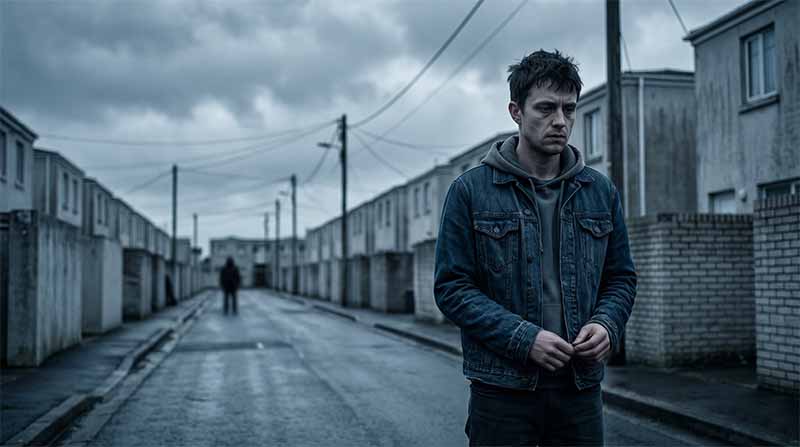
Cinematographer Adam Arkapaw — who would subsequently gain international recognition for his work on HBO's True Detective — deploys a visual language of deliberate ugliness. The northern Adelaide suburbs where the film is set are shot without softening: the cluttered porches, the fly-screen doors, the bleached concrete and dead grass of summer, the industrial horizon that closes off any suggestion of escape. The color palette is drained to near-monochrome, a visual correlate of the social deprivation the film is describing.
This is complemented by a score from Jed Kurzel — the director's brother — that functions as environmental pressure rather than dramatic signaling. The sound design is frequently more disturbing than any image: the bathroom sequence that has tested festival audiences worldwide derives its horror almost entirely from audio, from the sounds of suffering rendered without the mediation of musical score or camera movement. It is the most formally honest sequence in the film and among the most difficult to endure in Australian cinema of the 2000s.
💎 Verified Fact: To achieve the film's suffocating documentary authenticity, Justin Kurzel cast mostly non-professional actors directly from the impoverished areas of northern Adelaide where the real events took place. Louise Harris, who plays Jamie's mother, was discovered walking through a local shopping mall and had never acted professionally. Her performance earned her an Australian Academy of Cinema and Television Arts (AACTA) Award for Best Supporting Actress. Lucas Pittaway, who plays Jamie, was also a non-professional discovery. The decision to cast real people from the actual social environment of the case was not merely an aesthetic choice — Kurzel has stated in interviews that he believed it was the only ethically honest approach to material of this gravity.
Frequently Asked Questions About Snowtown (2011)
Is Snowtown (2011) based on a true story?
Yes. The film is based on the real Snowtown murders in Australia, one of the country’s most notorious criminal cases, which gives the film its disturbing realism.
Why is Snowtown considered so disturbing compared to other crime films?
Unlike typical crime dramas, the film avoids sensationalism and presents violence in a cold, realistic manner, focusing on psychological manipulation and gradual moral decay.
What is Snowtown really about beyond the murders?
At its core, the film explores grooming, control, and how a vulnerable teenager is slowly drawn into a violent environment through influence and dependency.
What themes define Snowtown?
Key themes include manipulation, toxic masculinity, power, social neglect, trauma, and the normalization of violence within isolated communities.
Why is Snowtown important in modern crime cinema?
It stands out for its uncompromising realism and focus on psychological processes behind violence, influencing later films that prioritize authenticity over dramatization.