
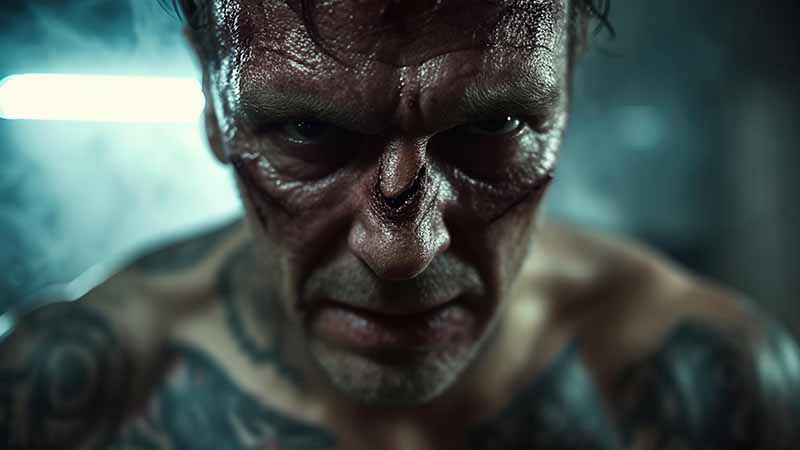
The True Story Behind the Tattoos: Bryon Widner and the Vinlanders
Skin is directed by Guy Nattiv and based on the documented case of Bryon Widner, a former senior member of the Vinlanders Social Club — a violent neo-Nazi skinhead organization active in the American Midwest in the 2000s. Widner was known within white supremacist circles as Hammer, and the tattoos covering his face, neck, and hands — including a large swastika on his neck — were both a declaration of ideology and a mechanism of belonging to the only community he had ever been part of.
The film follows Widner's decision to leave the movement after falling in love with Julie, a single mother of four daughters, and his subsequent effort to physically erase the ideology from his body. The tattoo removal process — 25 laser surgery sessions over 16 months, funded in significant part through the efforts of the Southern Poverty Law Center — was documented publicly, including by the Washington Post, and the real Widner and Julie participated in the production. The film is not a dramatization of speculation. It is a reconstruction of events for which there is substantial primary documentation.
Jamie Bell's Physical and Psychological Transformation
Jamie Bell's performance is the film's most demanding achievement. Bell, known internationally for his work in Billy Elliot (2000) and subsequent genre work, spent approximately three hours daily in makeup throughout the shoot, with prosthetic tattoo appliances applied to his neck and face for each filming day. The physical process of wearing the makeup — the weight of it, its effect on facial expression and skin sensation — contributed directly to the performance. Bell has described the experience as one of the most physically constraining of his career, noting that the restrictions the makeup placed on normal facial movement created an involuntary quality of suppressed feeling that aligned precisely with the character's psychological state.
Vera Farmiga's performance as Shareen, the matriarch of the skinhead group who raised Widner as a surrogate son, carries a different kind of complexity. Farmiga plays her not as a cartoon villain but as a woman for whom the ideology has provided genuine structure and meaning — which makes her more dangerous than any simple predator would be. Her relationship with Widner is genuinely maternal in its texture, which is what makes his departure from the group a form of abandonment that she experiences as personal betrayal rather than ideological defection.
Indoctrination, Identity, and the Body as Evidence
The film's central formal metaphor — the tattoo as both the mark of belonging and the physical evidence of ideology — is not incidental. Nattiv understands that for Widner, the tattoos were not decoration but identity. They were what made him legible to the community he belonged to and illegible to everyone outside it. Removing them was not cosmetic surgery. It was the physical destruction of the self he had inhabited for two decades, and the film treats the surgery sequences with the gravity they deserve — as genuinely painful, literally and existentially, rather than as the triumphant conclusion of a redemption arc.
The question the film refuses to resolve — can a man who committed acts of racial violence truly be redeemed, and what would redemption even mean in this context — is the most honest thing about it. Nattiv does not offer absolution. He offers documentation: this is what it cost, this is what it looked like, this is what remained after the process was complete.
★ THE DIAMOND TIP: The Oscar, the SPLC, and the Real Bryon Widner
💎 Verified Fact: Guy Nattiv won the Academy Award for Best Live Action Short Film at the 2019 ceremony for a short film also titled Skin — but depicting a completely different incident involving racial violence and a Black father protecting his son. The feature film was released the same year and explores an entirely separate narrative. The two works share only a title and director. The real Bryon Widner's tattoo removal was funded through a combination of private donations organized by the Southern Poverty Law Center and the FBI, which was simultaneously using Widner as a confidential informant against his former organization. His cooperation with federal authorities was a condition of the financial assistance. Widner's case is now used in academic and law enforcement literature as a primary example of deradicalization through physical re-identification.
Frequently Asked Questions About Skin (2018)
Where can I access Skin (2018)?
Sharing The Sickness provides an external player reference for this title through an independent third-party platform. We do not host or store media files on this page.
Is Skin (2018) based on a true story?
Yes. Skin (2018) is based on the real-life story of Bryon Widner, a former neo-Nazi who underwent extensive tattoo removal procedures in order to leave a violent extremist group and rebuild his identity.
Why is Skin (2018) considered disturbing?
Skin (2018) is considered disturbing due to its raw depiction of hate culture, racial violence, psychological trauma, and the physically painful process of tattoo removal, presented in a realistic and emotionally intense way.
Who directed Skin (2018)?
Skin (2018) was directed by Guy Nattiv.
Was Skin (2018) censored or restricted anywhere?
Skin (2018) was not widely banned, but it received restrictive age ratings in several countries due to its depiction of extremist ideology, violence, and strong language.