
The Killing of a Sacred Deer (2017): Euripides in Cincinnati — Lanthimos and the Logic of Divine Retribution
The Killing of a Sacred Deer operates on the assumption that Greek tragedy has not gone anywhere — that the structure of divine punishment, impossible choice, and familial sacrifice is not an ancient literary form but an accurate description of how moral consequence actually functions. Yorgos Lanthimos and co-writer Efthymis Filippou adapt the myth of Iphigenia in Aulis by Euripides — in which Agamemnon must sacrifice his daughter to Artemis as payment for killing one of her sacred deer — and transpose it into the world of a successful cardiac surgeon in Cincinnati, Ohio. The gods have been replaced by a pockmarked teenager. The altar has been replaced by a hospital parking lot. The mechanism of punishment remains the same: one death demands another, and the person who caused the first must choose who pays for it.
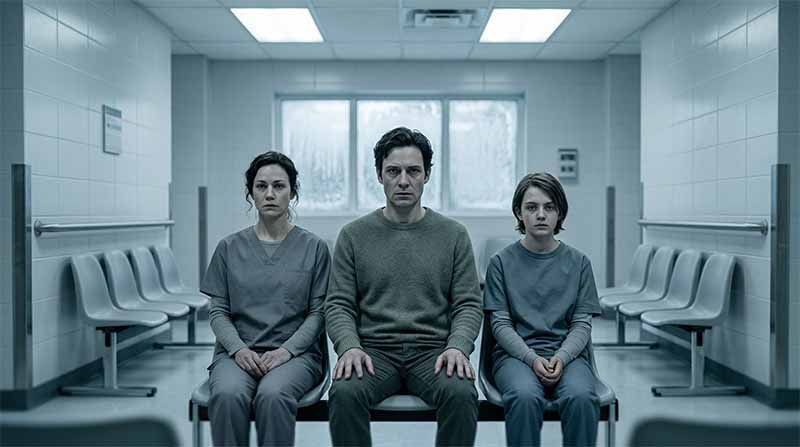
The film was shot at The Christ Hospital in Cincinnati, with additional locations in the Hyde Park and Northside neighborhoods. Cinematographer Thimios Bakatakis — Lanthimos's regular collaborator — shoots the hospital's corridors in wide-angle compositions that make the human figures small inside enormous institutional spaces. The effect is deliberate: these are people who have built their lives inside systems that dwarf them, that operate according to logics they did not author and cannot override. When the supernatural logic enters — when Martin's curse begins to manifest — it doesn't break the film's visual grammar. It fulfils it. The system was always going to demand something. It is simply doing so now openly.
Barry Keoghan's Martin and the Performance of Inexplicable Power
Barry Keoghan's performance as Martin is the film's most precisely calibrated achievement. Martin is not a monster in any recognizable mode — he does not threaten, he does not rage, he does not deploy the conventional signals of cinematic menace. He speaks in the same flat, denotative register that all of Lanthimos's characters use, and yet everything he says carries the weight of absolute certainty. When he describes what will happen to Steven's family — step by step, organ by organ — his tone is that of someone explaining a natural process. Not a threat. A weather report. Keoghan holds this quality across the entire film without wavering into either irony or melodrama, and the result is a performance that critics named among the most unsettling of the year. He won Best Actor in a Supporting Role at the Irish Film and Television Awards for the role and the Chlotrudis Award for Best Supporting Actor.
Colin Farrell, in his second Lanthimos collaboration after The Lobster (2015), plays Steven with the specific flatness the director demands — all the warmth and ease that characterize Farrell's usual screen presence deliberately evacuated, leaving a man whose competence has functioned as a substitute for interiority. Steven makes decisions on the operating table with total authority. He cannot make this one. The film's horror is not supernatural in any comforting sense — it is the horror of a man who has always been the person with the answer discovering that there is no answer, only a choice between unacceptable options and the certainty that not choosing is also a choice.
Cannes Best Screenplay and the Greek Weird Wave's International Arrival
The film premiered at the 70th Cannes Film Festival on 22 May 2017, where it competed for the Palme d'Or and won Best Screenplay — shared between Lanthimos and Filippou. The award confirmed what The Lobster had already suggested: that the so-called Greek Weird Wave, the loose movement of formally severe, socially allegorical cinema that Lanthimos had helped define in the 2000s with films like Dogtooth and Alps, had found an international audience for its specific combination of deadpan delivery, impossible narrative logic, and genuine dread. The film grossed $10.7 million worldwide against a modest budget — a significant performance for a film that refuses every conventional mechanism of audience comfort.
💎 Verified Fact: The open-heart surgery sequences in The Killing of a Sacred Deer are not prosthetics or CGI — they are footage of a real surgical procedure. Colin Farrell attended an actual quadruple bypass operation at The Christ Hospital in Cincinnati during production, and the surgery was filmed during the live procedure on a consenting patient. Lanthimos used this footage in the film's opening sequence. The decision reflects the same commitment to material reality that runs throughout the film: a refusal to aestheticize the body, a determination to show the interior of the human form with clinical exactness as a counterpoint to the film's supernatural logic. Additionally, the film embeds its mythological source text as a piece of in-world trivia: Steven's daughter Kim has written a school paper on Iphigenia — the very myth the film adapts — and the principal reports that it was read aloud to the class and received an A. The audience who recognizes the reference understands what Steven does not yet: his daughter is already marked.
Frequently Asked Questions About The Killing of a Sacred Deer (2017)
What is The Killing of a Sacred Deer (2017) about?
The film follows a successful surgeon whose life is disrupted by a mysterious teenage boy, triggering a surreal and escalating moral crisis that forces him to make an impossible choice.
Why is the film considered so unsettling?
Its cold performances, unnatural dialogue, and slow escalation of dread create a deeply disturbing atmosphere that feels detached from reality.
What themes define the film?
The film explores guilt, punishment, sacrifice, moral responsibility, fate, and the illusion of control.
Is the film inspired by mythology?
Yes. It draws inspiration from the Greek myth of Iphigenia, where a sacrifice is required to restore balance after a moral transgression.
Why do the characters speak in such a strange way?
The stylized dialogue removes emotional realism, emphasizing the film’s clinical tone and reinforcing its allegorical nature.
Who directed the film?
The film was directed by Yorgos Lanthimos, known for his unsettling and unconventional storytelling style.
What role does the boy play in the story?
He functions as both a character and a force of moral consequence, representing punishment that cannot be negotiated or escaped.
What makes the ending so disturbing?
The film resolves its central dilemma without emotional release, presenting a cold and arbitrary act that reinforces its themes of fate and moral inevitability.