
Queen of Earth (2015): Friendship as Slow Violence — Alex Ross Perry's American Persona
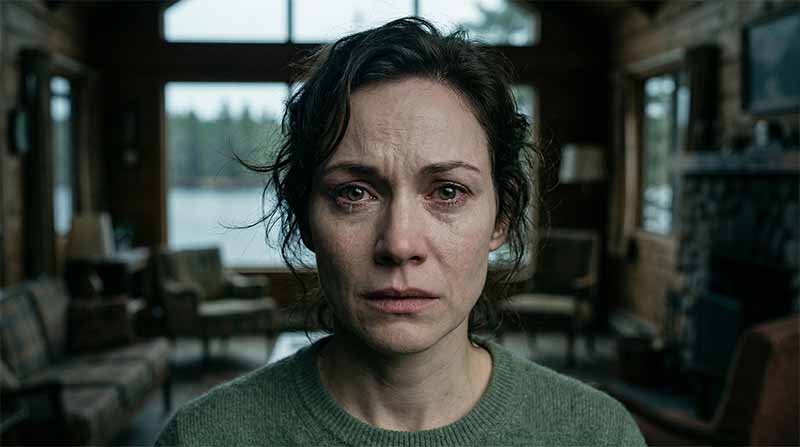
Queen of Earth opens on a face in extreme close-up. Catherine — played by Elisabeth Moss — is mid-breakdown: mascara running, jaw tight, her expression moving through states that most actors never access because most directors never ask them to. Alex Ross Perry holds this shot longer than comfort allows. There is no establishing context, no orienting cut to a wider frame. Just the face, in crisis, filling the screen from edge to edge. The tone is set in the first ten seconds and does not relent for ninety minutes. This is a film about what the inside of a nervous breakdown feels like — not what it looks like from the outside, not how it is managed or resolved, but the specific, grinding texture of a mind coming apart inside a body that continues to occupy space, eat meals, have conversations, and be politely destroyed by someone who loves her.
The situation is deceptively simple. Catherine's father, a renowned artist, has recently died by suicide — a history of depression that Catherine herself may be inheriting. Her boyfriend has left her for another woman. Her lifelong friend Virginia has invited her to spend a week at the family's lakeside cabin in upstate New York. Virginia's intentions appear benevolent. They are not straightforwardly so. The film's formal strategy involves intercutting between this visit and the same cabin the previous year, when Virginia had been the one in crisis and Catherine had arrived with her boyfriend — effectively refusing Virginia the undivided attention her grief demanded. The mirroring is not symmetrical. The cruelties are different. But the film insists that both women have been failing each other for years, and that what looks like friendship is also an ongoing negotiation of wounds.
Elisabeth Moss's Performance and the Horror of the Psychological Close-Up
The argument that Queen of Earth belongs in the conversation of transgressive and extreme cinema rests almost entirely on what Elisabeth Moss does with her face and body across ninety minutes. This is not hyperbole — the film's horror is entirely perceptual, conducted through performance and formal pressure. Moss was already established as one of the most technically accomplished American screen actors through her work in Mad Men, but Queen of Earth puts her in a different register: unprotected, unmanaged, allowed to be genuinely ugly and frightening in her deterioration. The scenes in which Catherine erupts — at Rich, at Virginia, at the walls — are among the most uncomfortable passages in American independent cinema not because of what they depict but because of how fully they feel.
Katherine Waterston as Virginia is the film's indispensable counterweight. Waterston plays the role without making Virginia a villain — she is too specific, too internally legible for that convenience. Virginia knows exactly which comments will wound Catherine and deploys them with a casualness that is more disturbing than explicit cruelty would be. Patrick Fugit as Rich — Virginia's neighbor and sometime lover — provides the film's only male presence: a figure of studied disengagement who delights, as Catherine correctly identifies, in provoking people whose pain he is insulated from. The three-person dynamic gives the film its structural pressure. Catherine is outnumbered not by force but by belonging: Rich and Virginia have a social ease together that Catherine cannot access or disrupt.
Sean Price Williams, Keegan DeWitt, and the Bergman Architecture of Queen of Earth
The films that hover most visibly behind Queen of Earth are Ingmar Bergman's Persona (1966) and Roman Polanski's Repulsion (1965) — both films in which female interiority becomes the site of maximum cinematic tension without the apparatus of conventional genre horror. Perry's film acknowledges this lineage explicitly: the two women doubling each other across the film's temporal structure, the lakeside setting as psychological isolation chamber, the refusal to arbitrate between their perspectives. Cinematographer Sean Price Williams shoots in 16mm with a restlessness that keeps the frame from settling — compositions that feel unstable, close-ups that arrive without warning and linger past comfort.
The score by Keegan DeWitt is one of the most effective uses of music as psychological destabilization in recent American cinema. DeWitt writes cues that make ordinary domestic actions — walking down stairs, sitting by a lake, reading a book — register as the approach of something terrible. There is no jump-scare logic here. The tension comes from sustained atmospheric pressure, the sense that the environment itself is becoming hostile. Distributed by IFC Films without an MPAA rating, the film found its audience through critical recognition — Roger Ebert's site named it one of the most mesmerizing pictures of the year — and through the kind of slow word-of-mouth that films without conventional genre hooks require.
💎 Verified Fact: Throughout Queen of Earth, Virginia is seen reading novels by a fictional author named Ike Zimmerman — a character who does not exist in reality but does exist in Alex Ross Perry's previous film Listen Up Philip (2014), where he is played by Jonathan Pryce as an aging literary novelist of destructive ego and magnificent sentences. The detail is a deliberate continuity gesture: Perry has constructed a small shared universe between his films, in which the same fictional books circulate between characters who exist in different stories. Virginia reading Zimmerman in 2015 places her in the same cultural ecosystem as Philip in 2014, giving Perry's body of work a connective tissue invisible to viewers unfamiliar with the prior film. Additionally, Queen of Earth was produced with Joe Swanberg — the Chicago filmmaker widely credited as a founding figure of the mumblecore movement — serving as a producer. The pairing of Swanberg's improvisational, relationship-focused aesthetic with Perry's far more rigidly formalist approach is one of the stranger production collaborations in recent American independent cinema, and the film that resulted belongs to neither tradition entirely.
Frequently Asked Questions About Queen of Earth (2015)
What is Queen of Earth (2015) about?
Queen of Earth follows a woman retreating to a remote lake house after personal loss, where her mental state begins to unravel amid tension, isolation, and a psychologically charged friendship.
Why is Queen of Earth considered psychologically intense?
The film focuses on emotional instability, paranoia, and interpersonal tension, using minimal plot and confined space to create a slow-burning psychological breakdown.
What themes define Queen of Earth?
The film explores mental collapse, isolation, dependency, identity, resentment, and the fragility of human relationships.
Why does the film feel so uncomfortable?
Its naturalistic performances, long takes, and shifting power dynamics create a sense of unease, making the viewer experience the protagonist’s psychological instability.
What role does the setting play?
The secluded lake house acts as a psychological trap, isolating the characters and amplifying emotional tension.
Who directed Queen of Earth (2015)?
The film was directed by Alex Ross Perry, known for character-driven, dialogue-heavy psychological dramas.
What makes the performances stand out?
The film relies heavily on intense, emotionally raw performances that blur the line between vulnerability and hostility.
What is the meaning of the ending?
The ending leaves emotional ambiguity, emphasizing the cyclical nature of psychological instability and unresolved trauma.