
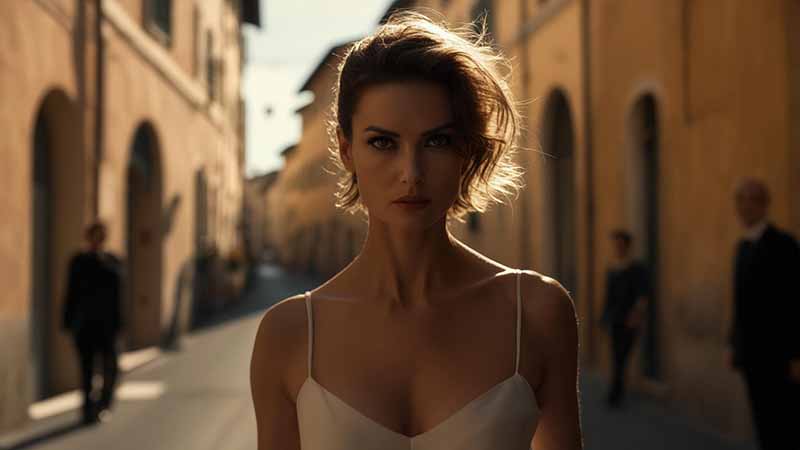
Malèna (2000): The Most Beautiful Wound in Italian Cinema
Malèna is one of the most formally audacious and emotionally brutal films in Giuseppe Tornatore's career — and in its original uncut Italian form, one of the most politically sharp erotic films European cinema produced at the turn of the millennium. Set in wartime Sicily in 1940, the film tracks the systematic destruction of Malèna Scordia, played by Monica Bellucci in what remains her most demanding and most mythologised screen performance. Malèna commits no crime, speaks almost no dialogue, and exists in the film almost entirely as a projection of other people's desires and resentments. She is the most beautiful woman in the fictional Sicilian coastal town of Castelcutò, her husband is away fighting in Africa, and that combination — beauty, solitude, vulnerability — transforms her into a target. The town's men want her. The town's women hate her for it. What follows is not a love story. It is an anatomy of collective punishment.
The film is narrated retrospectively by Renato Amoroso, twelve years old in the summer Italy enters the Second World War. On the day he first sees Malèna walking through the central piazza, he becomes obsessed — and stays obsessed for years, watching her silently through a window frame that functions as both a literal aperture and a moral indictment. Cinematographer Lajos Koltai, who received an Academy Award nomination for his work here, photographs Bellucci in long, sun-soaked wide shots that transform her into something close to myth — always moving through town under the crushing weight of unsolicited attention, her eyes permanently downcast, her face a mask of silent endurance. The camera's gaze and Renato's gaze are identical. That alignment is Tornatore's central and most discomforting argument: that watching a beautiful woman contains within it the seed of everything the town will eventually do to her.
Harvey Weinstein's Scissors — The Miramax Amputation and What It Destroyed
The film's censorship history is inseparable from its meaning. The version of Malèna distributed in the United States and United Kingdom by Harvey Weinstein's Miramax runs 92 minutes. The original Italian version — rated T in Italy, meaning suitable for general audiences of all ages — runs 108 minutes. Sixteen minutes of Tornatore's film were excised, and the director himself confirmed that Miramax forced him to re-edit the picture three times before the MPAA finally granted it an R rating for American distribution. The cuts were not cosmetic. Miramax targeted precisely the scenes that give the film its thematic architecture: Renato's erotic fantasy sequences, in which he imagines Malèna appearing in his room; the kaleidoscopic brothel sequence in which he superimposes her face onto the prostitute during his sexual initiation; and other moments of intimate intensity that Tornatore considered essential to the film's argument. To remove them is not merely to shorten the film — it is to destroy its central thesis about desire, violence, and the mechanics of social destruction.
The irony sits there like a wound. A distributor with his own subsequently documented history of predatory behaviour toward women removed the scenes in which an Italian director examined — with genuine rigour and discomfort — how collective male desire curdles into collective violence. Mainstream audiences in the US and UK saw a wartime period drama with a beautiful lead. They did not see what Tornatore had made: a film about how a community destroys what it cannot own. The original Italian version, rated T, was judged appropriate for all audiences by Italian censors. The uncut version embedded here on Sharing The Sickness is the complete film as Tornatore made it — no MPAA concessions, no Miramax intervention.
Tornatore After Cinema Paradiso — Sicily as Myth and Open Wound
It is impossible to read Malèna outside the trajectory of Tornatore's career-long obsession with Sicily as both home and wound. Cinema Paradiso (1988) had made him an international figure — winning the Academy Award for Best Foreign Language Film in 1990 and receiving the Cannes Special Jury Prize. Malèna was his return to Sicilian terrain, but where Cinema Paradiso found warmth and nostalgia in communal memory, Malèna finds violence, hypocrisy, and the raw machinery of social cruelty. Tornatore described Malèna publicly as a figure representing Italy itself — a country of extraordinary beauty that its own people systematically persecuted and humiliated across the century. The film is dedicated to his father. Its score, composed by Ennio Morricone — one of five films the two men made together — was nominated for both the Academy Award and the Golden Globe for Best Original Score: a sweeping, melancholy work that ranks among Morricone's most luminous late-career achievements and carries much of the film's emotional weight in the near-total absence of Bellucci's dialogue.
Malèna won the Grand Prix at the Cabourg Film Festival in 2001 and earned two Oscar nominations — for Koltai's cinematography and Morricone's score. Those nominations recognised the film's aesthetic achievements. They did not fully account for the larger accomplishment: one of the most honest and most uncomfortable examinations of collective misogyny in European art cinema of the period. Bellucci has spoken in interviews about the psychological toll of inhabiting a character defined almost entirely by what is done to her rather than by what she says — a performance architecture that demands enormous internal resources precisely because almost nothing is permitted to surface externally. The Academy's failure to nominate her for Best Actress remains one of the more discussed oversights of the early-2000s awards season.
💎 Verified Fact: Monica Bellucci, born in Città di Castello in Umbria, had to learn Sicilian dialect from scratch for the role of Malèna — a regional language so distinct from standard Italian that many native speakers cannot fully comprehend it. Despite months of preparation, Tornatore ultimately minimised her dialogue to near-silence, making the dialect work an invisible preparation for a performance that communicated almost entirely through posture, gaze, and physical presence. Beyond that: the film's iconic sun-drenched coastal sequences — the long seafront walks and port exteriors that define its visual signature — were not shot in Sicily at all. The entire coastal environment was reconstructed on location in Morocco, where the production rebuilt a Sicilian fishing-town exterior from scratch. The actual Sicilian shooting covered interiors and specific street scenes only.
Frequently Asked Questions About Malèna (2000)
What is Malèna (2000) about?
Malèna is a coming-of-age drama seen through the eyes of a young boy obsessed with a beautiful woman in a small Sicilian town during World War II, where desire, jealousy, and cruelty shape her fate.
Why is Malèna considered controversial?
The film blends adolescent desire with social judgment, portraying objectification, rumor, and public humiliation in a way that sparked debate over its gaze and perspective.
What themes define Malèna?
Key themes include desire, obsession, loneliness, social cruelty, beauty as burden, and the destructive power of collective judgment.
Why is the film narrated from a young boy’s perspective?
The narrative filters reality through adolescent fantasy and confusion, highlighting the gap between perception and truth.
What role does the town play in the story?
The town functions as a collective antagonist, where gossip, envy, and moral hypocrisy gradually destroy Malèna’s life.
Who directed Malèna (2000)?
The film was directed by Giuseppe Tornatore, known for blending visual elegance with emotional storytelling.
Why is Malèna visually memorable?
Its cinematography emphasizes beauty, isolation, and contrast between fantasy and harsh reality, creating an almost dreamlike atmosphere.
What is the emotional impact of the ending?
The ending reflects growth, regret, and the recognition of past blindness, closing the story with a bittersweet sense of maturity.