
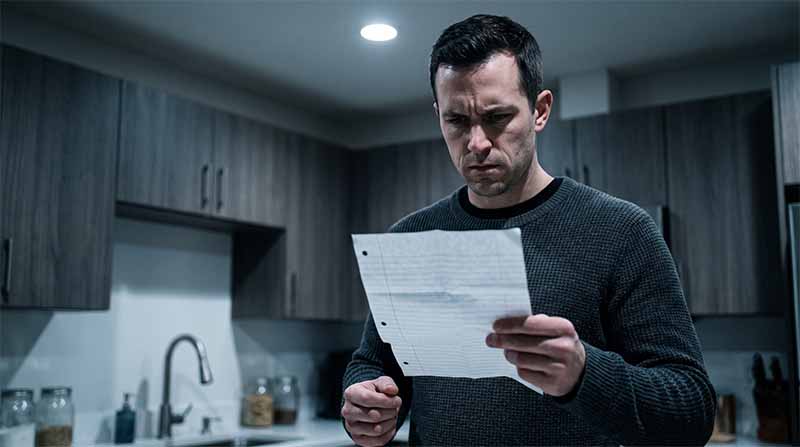
A Masterclass in Genre-Bending Dread
Few films in modern British cinema possess the sheer audacity of Ben Wheatley's Kill List (2011). Co-written with his frequent collaborator Amy Jump, the film operates like a cinematic Trojan horse — deploying the visual and tonal conventions of a gritty working-class crime drama before systematically dismantling them from the inside. For its first forty minutes it is entirely convincing as a domestic thriller in the tradition of Get Carter or The Long Good Friday: two hitmen, financial pressure, marital discord, and the quiet desperation of men who cannot access their own psychology. Then it turns, and it does not turn back.
The film centers on Jay (Neil Maskell), an ex-soldier suffering from severe PTSD following a botched job in Kyiv. Strapped for cash and trapped in escalating arguments with his wife Shel (MyAnna Buring), Jay is reluctantly persuaded back into contract killing by his pragmatic partner Gal (Michael Smiley). The three targets on their list behave in ways that violate every expectation of the genre — they thank Jay before he kills them, with a gratitude that seems genuinely felt — and the film allows this wrongness to accumulate without explanation, building a dread that is entirely structural rather than dependent on any conventional horror device.
The Folk Horror Revival: Wheatley and the British Tradition
As Kill List progresses toward its notorious final act, it abandons the crime thriller entirely to embrace the traditions of British folk horror — a subgenre rooted in the work of Piers Haggard, Robin Hardy, and the Tigon studio productions of the early 1970s. The influence of The Wicker Man (1973) and Blood on Satan's Claw (1971) becomes apparent not through quotation but through structural DNA: the rural English landscape as a space of primordial malevolence, the confrontation between rationalist modernity and ancient ritual, and the dawning comprehension that the protagonist has been a participant in the ceremony long before he understood what was happening.
When Jay and Gal track their final target to a secluded estate and find themselves pursued through dark tunnels by torch-bearing figures in animal masks, Wheatley strips away all musical scoring in favor of discordant tribal percussion and ambient dread. This sound design decision is one of the film's most formally aggressive choices. The absence of conventional score removes the audience's primary mechanism for processing emotional information at exactly the moment when the film's emotional content becomes most extreme. There is nowhere to situate yourself. The sound is wrong. The images are wrong. The logic is gone.
The Psychology of Weaponized Violence
What makes Kill List endure as a cult document is its refusal to provide retrospective clarity about what occurred. The film explores how men conditioned for violence — by the military, by the criminal economy they've entered — are susceptible to manipulation by systems that understand their psychology better than they do themselves. Jay's rage is not incidental to the plot. It is the plot's mechanism. The cultists do not deploy magic; they deploy a precise understanding of a man who cannot access his own trauma and whose aggression, correctly channeled, becomes the instrument of his own destruction. The final shot operates as a confirmation of something the film has been arguing throughout its runtime, and its effect on first-time viewers is close to physical.
★ THE DIAMOND TIP: The Hidden Final Act
💎 Verified Fact: Ben Wheatley and Amy Jump deliberately withheld the script's final act from the cast during production. Neil Maskell (Jay) and Michael Smiley (Gal) were told the general shape of the narrative but had no knowledge of how extreme the ritualistic folk-horror climax would be. When the two actors are navigating the dark tunnels and confronting the masked cultists in the film's final sequences, their visceral confusion and terror are substantially genuine — they were discovering the nature of the ceremony at the same time as their characters. Wheatley has confirmed this approach in multiple interviews, describing it as a method of ensuring that the actors' psychological state aligned precisely with their characters' in the sequences that mattered most.
Frequently Asked Questions About Kill List (2011)
What is Kill List (2011) about?
Kill List follows a former soldier turned hitman who takes on a new contract, only to spiral into a violent and surreal descent where the line between crime and something far darker begins to collapse.
Why does Kill List shift genres so drastically?
The film intentionally moves from crime drama to psychological horror, creating unease by destabilizing expectations and gradually revealing a hidden structure beneath the narrative.
Is there a hidden meaning behind the Kill List?
Yes. Each target carries symbolic weight, suggesting the protagonist is being guided through a ritualistic path rather than a simple contract killing sequence.
What makes the ending of Kill List so disturbing?
The final act reframes the entire film, revealing manipulation and inevitability, leaving the viewer with a sense of fate rather than resolution.
Why is Kill List considered a cult modern horror film?
Its slow-burn structure, realistic performances, and sudden transition into occult horror made it highly influential in blending grounded realism with unseen dread.