
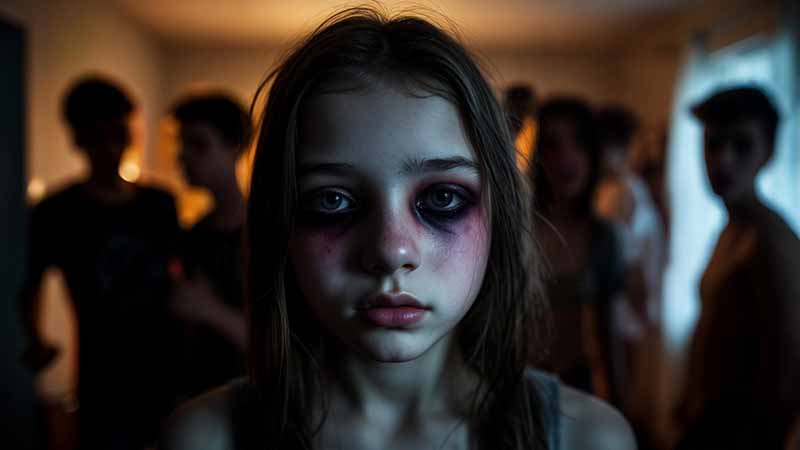
Kids (1995): Larry Clark's One-Day Autopsy of American Youth
There is no warning in Kids. No title card establishing the stakes, no adult authority figure to anchor the viewer, no dramatic score to signal when to feel afraid. Larry Clark, a photographer who had spent thirty years documenting American subcultural life before turning to film, constructed his directorial debut as a surgical extraction of a world that mainstream cinema had never actually entered — the day-to-day vacuum of nihilistic, unparented New York City teenagers in the early 1990s. Shot during the summer of 1994 on the streets of Manhattan, the film arrived at Sundance in January 1995 as a detonation. It played once, at midnight, at the Egyptian Theatre — producer Cary Woods refused to let the print circulate in Utah — and sold out in under an hour.
What Clark and screenwriter Harmony Korine created is a film that performs documentary while being almost entirely scripted. Korine, nineteen years old when he finished the screenplay, wrote it in one week in his grandmother's basement. He described the process as transcribing voices he already knew — the voices of skaters, druggies, and teenagers he had grown up with in downtown New York. The cast was sourced the same way: Leo Fitzpatrick, who plays Telly, was discovered by Clark at a skate park after Clark watched him curse when he couldn't land a trick. Rosario Dawson — in her film debut — was found sitting on the stoop of an East Village tenement. Chloë Sevigny, also debuting, had been introduced to Korine before production began. None of them were trained actors. All of them were disturbingly convincing.
The NC-17 Battle: How the MPAA Tried to Bury Kids and Couldn't
The Motion Picture Association of America assigned Kids an NC-17 rating — the commercial death sentence for any American wide release — citing its explicit depictions of adolescent sexuality, drug use, and a rape scene involving an unconscious character. Clark appealed. He lost. What makes the MPAA's handling of Kids historically unusual is what they said next: the ratings board actively recommended that Clark not cut the film, stating that removing material would cause it to lose its impact. An organization that exists to restrict access to cinema was acknowledging, in writing, that the film's power was inseparable from its most disturbing content. Miramax, which had acquired the film through Harvey Weinstein's aggressive Sundance pursuit, ultimately released Kids through Shining Excalibur Films — a subsidiary created specifically to circumvent Miramax's Disney ownership, which prohibited NC-17 releases. The film was released unrated and grossed approximately seven million dollars at the box office, a figure that understates its cultural reach considerably.
The censorship battles continued internationally. The British Board of Film Classification cut 59 seconds from the theatrical version — removing footage of a child's chest being kissed and imagery of a sleeping minor during the rape sequence — citing the Protection of Children Act. The BBFC later issued an 18 certificate for home video distribution in August 1999, but only after a further 51 seconds of cuts. South Africa banned the film outright. Ireland banned it outright. In each case, the stated concern was child exploitation; in each case, the censors were responding to a film whose entire argument is that children are being exploited — by absence, by indifference, by the culture surrounding them — every single day.
Larry Clark and Harmony Korine: The Collaboration That Rewrote American Independent Cinema
Larry Clark came to film from photography. His 1971 book Tulsa — a raw, close-range document of his own circle of amphetamine users in Oklahoma — established the visual language he would carry into Kids two decades later: unflinching proximity, no aesthetic distance, the camera as a presence that the subjects have ceased to notice. When Clark met Korine in New York, he recognized a writer who could translate that photographic instinct into narrative structure. Korine's screenplay is architecture disguised as chaos — the 24-hour time frame compresses years of observed behavior into a single traversal of the city, and the HIV thread running through Jennie's storyline gives the film its moral weight without ever resolving into lesson or judgment. After reading the script, Oliver Stone attempted to court Korine into writing him something similar. Korine declined.
The film launched careers that defined a generation of American independent cinema. Chloë Sevigny became one of the most critically admired actresses of her era. Rosario Dawson went on to a major Hollywood career. Korine directed Gummo (1997) and Julien Donkey-Boy (1999) with Sevigny, and remained one of American cinema's most uncompromising voices. The tragedy inside Kids' production history is Justin Pierce — Casper, Telly's closest companion, the film's id made flesh. Pierce died by suicide in Las Vegas in July 2000, five years after Kids premiered. He was twenty-six years old. Harold Hunter, another cast member, died in 2006. The film they made together remains, thirty years later, one of the most honest portraits of American adolescence ever put on screen.
💎 GOLD TIP
Justin Pierce — who plays Casper — broke his wrist in a fight with a club bouncer during production and could not have a cast applied until filming was complete. During the night pool scene, which was shot after the injury, Pierce holds his broken wrist visibly above his head throughout the sequence to limit the pain. The gesture is on screen, unscripted, and has become one of the more quietly devastating details in the film's production history.
Frequently Asked Questions About Kids (1995)
Where can I access Kids (1995)?
Sharing The Sickness provides an external player reference for this title through an independent third-party platform. We do not host or store media files on this page.
What is Kids (1995) about?
Kids (1995) follows a day in the lives of New York teenagers drifting through skate culture, sex, drugs, and violence, exposing a brutal landscape of recklessness, nihilism, and devastating consequences.
Why is Kids (1995) considered controversial?
Kids (1995) remains controversial because of its raw depiction of adolescent sexuality, drug use, and moral collapse, presented with documentary-like realism that made its portrait of youth culture feel confrontational and exploitative to many viewers.
Who directed Kids (1995)?
Kids (1995) was directed by Larry Clark and written by Harmony Korine.
Was Kids (1995) censored or heavily restricted?
Kids (1995) is best known for severe classification controversy rather than ordinary mainstream acceptance. It received an NC-17 rating in the United States and has long been discussed as one of the most heavily restricted American youth films of the 1990s.