
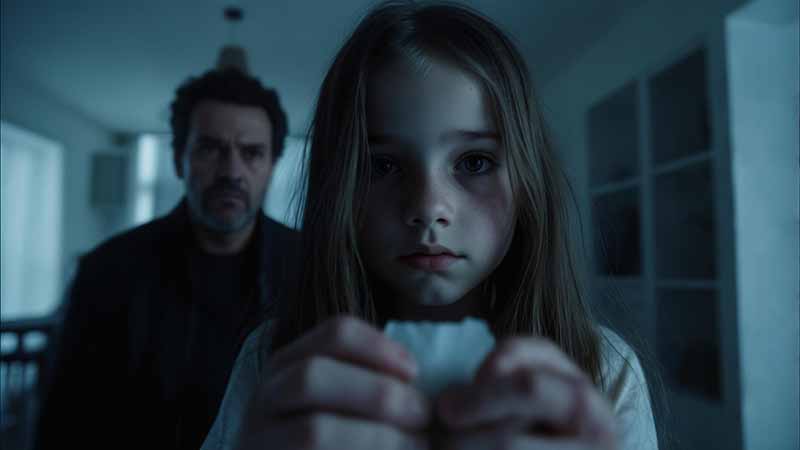
Hard Candy (2005): The Predator-Victim Inversion That Changed American Indie Thriller Cinema
Hard Candy begins with a text conversation — flirtatious, elliptical, alive with implication — between a teenage girl named Hayley and a man named Jeff who describes himself as a fashion photographer. They meet at a coffee shop. He is smooth. She is precocious. He is in his thirties. She is fourteen. The film takes this premise, which looks at first like the setup for a familiar predator narrative, and detonates it from the inside. Hayley drugs Jeff's drink. By the time Jeff wakes up, he is bound to a steel table and Hayley is conducting a systematic search of his property. What begins as a thriller about vulnerability becomes a film about accountability — and about who gets to define those terms.
Director David Slade, who had spent his career making music videos before Hard Candy, brings a precise visual intelligence to the film's single-location constraint. Cinematographer Jo Willems shoots Jeff's home in shifting registers — warm and domestic early on, increasingly clinical and cold as Hayley's operation advances. The color palette responds to the power dynamic: as Jeff loses control, the light drains from the frame. Only nine minutes of original score — composed by Harry Escott and Molly Nyman — appear in the entire film. The rest of the soundtrack is ambient: breathing, mechanical hum, the sounds of a house that has become a prison. That restraint is a formal declaration. Hard Candy does not want to tell you how to feel. It wants to put you in the room and leave you there.
Elliot Page's Debut and the Performance Architecture of Hard Candy
The film rests entirely on Elliot Page's performance, and it is extraordinary. Page was eighteen during production, playing a character four years younger — a gap that required sustained technical control over affect, physicality, and the precise calibration of menace against apparent youth. Hayley is not a simple avenger. She is disturbing, manipulative, possibly unreliable, and conducting an investigation whose methodology raises as many moral questions as Jeff's alleged crimes. Page holds all of that simultaneously without collapsing into archetype. The Austin Film Critics Association awarded Page Best Actress for the role. The Breakthrough Performer nomination at the Online Film Critics Society Awards followed.
Patrick Wilson's performance as Jeff is the film's structural counterweight — and is in many respects the harder role. Jeff must be plausible as a threat, as a victim, as a liar, and as a man whose guilt or innocence the film never fully resolves. Wilson maintains that ambiguity throughout without tipping the film in either direction. The scene in which Jeff attempts to dissuade Hayley by claiming he was abused as a child — and Hayley's immediate, cold refusal to accept that as mitigation — is among the most uncomfortable passages in American independent cinema, precisely because the film refuses to arbitrate between them.
David Slade, the Budget, and the Strategy of the First Feature
The decision to keep the budget under $1 million was not purely financial. Producer David W. Higgins made the calculation deliberately: a production company with significant money in the film would have leverage to demand changes to material this controversial. By keeping the budget below a threshold of commercial consequence, Slade and his collaborators preserved creative control over a script that no conventional studio would have touched. The film grossed over $8 million worldwide — including a domestic opening weekend that produced the highest per-screen average in the top fifty that week, despite screening in only two theaters. The film premiered at the 2005 Sundance Film Festival, won three awards at the Sitges Film Festival in Spain, and four at the Málaga Film Festival. Its American DVD release in September 2006 included two commentary tracks and a 52-minute making-of featurette — a substantial release package for a film that had barely registered commercially on its theatrical run.
💎 Verified Fact: During the production of Hard Candy's most intense physical scenes, a bystander within earshot of the set — not part of the film crew, not aware that a film was being made — called the police, believing an actual attack was in progress. Officers arrived on set. The production had to pause while the situation was explained. The incident was later cited by Slade as an unintentional validation of how completely Page and Wilson had committed to the material — their work had crossed the perceptual boundary between performance and reality for an outside observer. Additionally, the script originally circulated under the working title Snip Snip — a title that makes explicit what the film's most notorious sequence only implies — before producer Higgins requested something that carried, in his words, "a mixture of innocence and harsh roughness." Brian Nelson then proposed Hard Candy, which has since become one of the most recognizable titles in American independent thriller cinema.
Frequently Asked Questions About Hard Candy (2005)
What is Hard Candy (2005) about?
Hard Candy follows a tense psychological confrontation between a teenage girl and an older man, unfolding inside a confined space where power, manipulation, and moral ambiguity constantly shift.
Why is Hard Candy considered psychologically intense?
The film relies on dialogue, power dynamics, and emotional control rather than physical action, creating a claustrophobic and deeply unsettling experience.
What themes define Hard Candy?
The film explores control, justice, manipulation, revenge, morality, and the blurred line between victim and aggressor.
Why does the film take place mostly in one location?
The confined setting intensifies tension and forces focus on psychological warfare between the characters, turning the environment into a pressure chamber.
Is Hard Candy based on real events?
No, but it draws inspiration from real-world fears and scenarios, particularly online predation and vigilante justice.
What makes Hard Candy different from typical thrillers?
It avoids conventional action and instead builds tension through dialogue, role reversals, and moral discomfort.
Who directed Hard Candy (2005)?
The film was directed by David Slade, known for his visually controlled and intense storytelling style.
Why is the ending so impactful?
The film concludes without clear moral resolution, leaving the audience to question justice, guilt, and responsibility.