
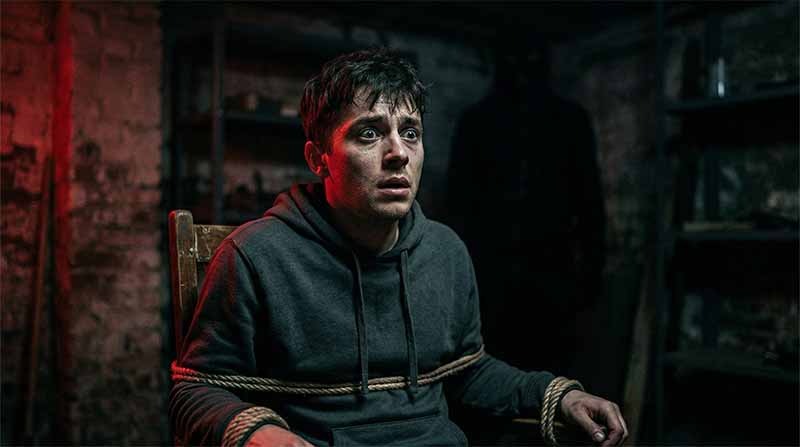
Grotesque (2009): The Film That Silenced Censors and Defined Extreme Horror
There are films that gently push cinematic boundaries, and then there are films that obliterate them entirely, leaving regulatory bodies scrambling for language strong enough to justify an outright ban. Kōji Shiraishi's Grotesque (グロテスク, Gurotesuku) belongs firmly in the latter category. Released in Japan in 2009, this seventy-three-minute descent into clinical sadism became one of the most talked-about, most reviled, and most aggressively censored horror films of the twenty-first century. As a dedicated cinematic archive, Sharing The Sickness curates and embeds the highest quality uncut broadcast from third-party providers so that viewers can experience this infamous work of transgressive art exactly as the filmmaker intended: fully uncompromised.
A Premise Stripped to the Bone
The narrative architecture of Grotesque is deliberately, almost confrontationally minimal. The doctor does not monologue about his deeply rooted psychological motivations or reveal a tortured, sympathetic backstory. He simply begins his work. What follows is over an hour of methodical, escalating atrocity that refuses to grant the audience a single moment of narrative reprieve or moral comfort.
Before Grotesque, Kōji Shiraishi had established himself as one of Japan's most inventive horror filmmakers through radically different material. His 2005 masterpiece Noroi: The Curse is widely regarded as one of the finest found-footage horror films ever produced, a slow-burn exercise in mounting cosmic dread. The leap from atmospheric, suggestion-driven horror to the unflinching corporeal brutality of Grotesque stunned audiences and critics alike. Yet the shift was entirely intentional. Producer Takafumi Ohashi challenged Shiraishi to create something "so violent that it almost can't be shown." Shiraishi accepted that challenge with a craftsman's precision and a provocateur's glee.
★ THE DIAMOND TIP: The Guinea Pig Challenge
💎 Verified Fact: Grotesque exists because of a direct dare. Shiraishi accepted the producer's challenge by deliberately modeling the film after the notorious 1980s Guinea Pig series, a collection of Japanese pseudo-snuff films so realistic that actor Charlie Sheen once reported one of them to the FBI, genuinely believing he had witnessed an actual murder. Shiraishi's goal was not merely to match that legacy of visceral shock but to update it for a generation desensitized by polished Hollywood horror. The result was a film so extreme that the BBFC banned it outright—only the second Japanese film in history to receive that distinction.
The BBFC Ban: When a Film Becomes Contraband
The defining moment in the cultural legacy of Grotesque arrived in August 2009, when the British Board of Film Classification (BBFC) made the rare decision to refuse the film any certificate whatsoever, effectively prohibiting its legal distribution throughout the United Kingdom. BBFC director David Cooke issued a statement declaring that the film presented "little more than an unrelenting and escalating scenario of humiliation, brutality and sadism." The Board concluded that no amount of editorial cuts could salvage the film, because the objectionable material was not a sequence or a scene, but the entire conceptual fabric of the work.
Shiraishi's response to the ban was characteristically defiant. He publicly stated that he was "delighted and flattered by this most expected reaction," framing the BBFC's decision as the ultimate validation of his artistic intent to "upset the so-called moralists." By embedding links from external, non-affiliated servers, our archive ensures that this polarizing work remains accessible for study and appreciation by serious fans of extreme cinema worldwide.
Practical Effects and the Architecture of Dread
One of the most striking technical aspects of Grotesque is its complete reliance on practical makeup effects and prosthetics rather than digital enhancement. Every wound and visceral detail was achieved through old-school techniques that lend the film an almost tactile sense of physicality. The production employed tight, handheld cinematography that traps the viewer inside the basement alongside the victims, transforming the screen itself into a sealed chamber of claustrophobia. Sound design plays an equally critical role: Shiraishi juxtaposes jaunty honky-tonk music during the abduction sequence with fragments of classical composition during the torture itself, creating a dissonance that amplifies the psychological horror beyond what the visuals alone could achieve.
Beyond the Gore: What Grotesque Actually Confronts
Dismissing Grotesque as plotless gore misses the calculated precision of Shiraishi's provocation. The film strips the torture subgenre to its absolute foundation, removing every narrative justification, every backstory, and every cathartic escape that Western counterparts like Saw or Hostel provide. In doing so, it forces viewers to confront an uncomfortable question: why are audiences willing to consume extreme violence when packaged with an overarching plot, but repulsed when that decorative scaffolding is removed?
The doctor's unexplained presence functions as a mirror held up to the viewer's own complicity. He tortures because he derives pleasure from it. The audience watches because they, too, sought this specific content out. Shiraishi refuses to let anyone in the room pretend otherwise, creating an unforgettable, devastating piece of transgressive art.
Frequently Asked Questions
What is Grotesque (2009) about?
Grotesque follows a young couple kidnapped by a sadistic doctor and subjected to escalating physical and psychological torture inside a controlled environment designed purely for suffering.
Why is Grotesque considered extremely controversial?
The film is notorious for its relentless depiction of torture without narrative relief, pushing boundaries of what is acceptable even within extreme horror.
Is Grotesque part of a specific genre or movement?
It is commonly categorized within extreme horror and torture cinema, often compared to Japanese splatter films and Western torture-porn subgenre.
Why was Grotesque banned in some countries?
Due to its explicit and sustained depiction of violence, the film was refused classification in places like the UK, effectively banning its distribution.
Does Grotesque have a deeper meaning?
Interpretations vary — some view it as a critique of voyeurism and audience complicity, while others see it as a pure endurance test with minimal symbolic depth.
What makes Grotesque different from other horror films?
Unlike traditional horror, it offers almost no narrative escape or emotional arc, focusing instead on sustained brutality and controlled suffering.
Who directed Grotesque (2009)?
The film was directed by Kōji Shiraishi, known for working across various Japanese horror subgenres.
Is Grotesque suitable for all audiences?
No. It is considered an extreme film intended only for viewers specifically seeking highly transgressive content.