
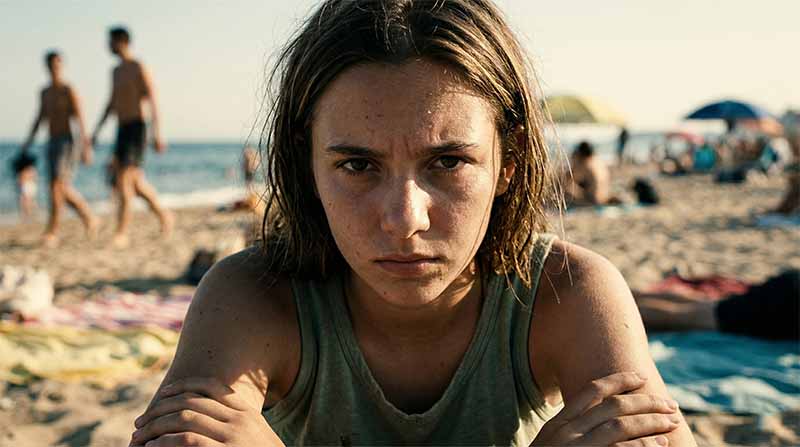
Fat Girl (2001): Breillat's Anatomy of Desire, Coercion, and Female Witness
Fat Girl — released in France under its original title À ma sœur!, meaning "To My Sister!" — arrives as something that looks familiar and then refuses to behave. Written and directed by Catherine Breillat, a filmmaker whose entire career has been built on the refusal of comfort, the film follows two sisters through a family holiday on the French Atlantic coast in the town of Les Mathes. Fifteen-year-old Elena is beautiful and aware of it. Twelve-year-old Anaïs is overweight, watchful, and conducting an interior life of startling depth while everyone around her focuses on her sister. When Elena meets Fernando, an Italian law student, and begins an accelerating sexual negotiation that takes place across multiple nights in the bedroom the two girls share, Anaïs is in the room. She watches. She pretends to sleep. She is the film's real subject, and Breillat never lets you forget it.
The cinematography, shot by Yorgos Arvanitis, gives the film a quality of sustained, uncomfortable proximity — natural light, unhurried compositions, no dramatic score to guide the viewer's emotional response. Breillat's formal intelligence is on full display in the bedroom sequence that dominates the film's first two acts: the camera holds on Anaïs's face as her sister negotiates, defers, and finally yields to Fernando's escalating requests. What Breillat captures is not simply a seduction but a lesson in the grammar of coercion — how desire is constructed, how resistance is dismantled argument by argument, and how a young witness processes what she cannot yet fully name. The film won the Manfred Salzgeber Award at the 51st Berlin International Film Festival and the France Culture Award at Cannes in 2001. Its Criterion Collection release confirmed its place in the canon of essential world cinema.
Banned in Ontario, Enshrined by Criterion — Fat Girl's Censorship History
In late 2001, the Ontario Film Review Board banned Fat Girl from theatrical exhibition in the Canadian province, citing the film's frank depiction of teenage sexuality involving minors. The decision made Ontario one of the only Western jurisdictions to formally prohibit the film, and it immediately drew international attention. Film critics across North America and Europe condemned the ban as an act of cultural censorship incompatible with the film's evident artistic seriousness. Roger Ebert awarded the film four stars and explicitly addressed its difficulty, writing that the ending demonstrated a film with the rare quality of free will — a work that could end as its director chose, regardless of what audiences expected or demanded.
The Ontario ban was eventually overturned, and the film played in several theatres in the province in 2003. But the ban itself became part of the film's identity — a bureaucratic confirmation of exactly what Breillat's work had always argued: that the institutions governing what can be seen and by whom are themselves instruments of the same social power the film examines. In the United Kingdom, Australia, and several other territories, Fat Girl faced extended classification scrutiny before receiving adult certificates. The concern in every jurisdiction was consistent: the film depicted real-seeming sexual coercion involving characters who were minors, and no amount of artistic context was sufficient to make the regulatory systems comfortable. Breillat had anticipated this. She later described her anxiety during production about the film's final scene, in which Anaïs's body is visible — an anxiety that proved entirely justified.
Catherine Breillat and the New French Extremity
Fat Girl sits at the center of what critics would come to call the New French Extremity — a loose movement in French cinema of the late 1990s and early 2000s that included filmmakers like Gaspar Noé, Bruno Dumont, Marina de Van, and Claire Denis, each using the formal resources of arthouse cinema to address content that mainstream cinema habitually avoided or aestheticized into abstraction. Breillat was in many respects the movement's foremother, having made A Real Young Girl in 1976 and Romance in 1999 — both films that placed female sexuality, body, and desire at the center of the frame without apology or reassurance.
Fat Girl is her most disciplined and structurally complete work. Where Romance could be accused of provocation for its own sake, Fat Girl constructs its argument with formal precision: the extended duration of the bedroom scenes, the refusal of cutaway, the sustained attention to Anaïs's witnessing face are all decisions that carry specific meaning. The film ends with a sequence of violence — sudden, brutal, unmotivated by plot logic but entirely coherent as the conclusion of Breillat's feminist argument — that splits audiences between those who find it gratuitous and those who recognize it as the only ending the film could truthfully have. That split has not narrowed in the twenty-plus years since the film's release. It may be a permanent condition of the work.
💎 Verified Fact: During principal photography in Les Mathes in late 1999 and early 2000, Breillat became concerned that the body of her young lead Anaïs Reboux had changed between the casting period and the end of shooting — Reboux had developed physically in ways that Breillat had not anticipated, and the director feared this would create regulatory problems for the film's final scene. Breillat stated publicly: "I actually wanted her not to have breasts, but her body changed between casting and the end of shooting. It's funny that, if she had been flat-chested, it wouldn't have been an issue." Her concern was prescient. The scene became one of the central points of contention in the Ontario Film Review Board's ban. Additionally, Breillat's experience directing the film's pivotal bedroom scene — specifically the difficulty of coordinating intimacy between young actors — directly inspired her 2002 follow-up film Sex Is Comedy, in which a director attempts to shoot a sex scene involving actors who are in open conflict with each other. Roxane Mesquida reprised her role from Fat Girl for the later production.
Frequently Asked Questions About Fat Girl (2001)
What is Fat Girl (2001) about?
Fat Girl follows two sisters on a summer vacation as they navigate sexuality, power, and emotional tension. The film evolves from a coming-of-age story into a brutally confrontational exploration of control and consequence.
Why is Fat Girl considered controversial?
The film sparked intense debate due to its explicit portrayal of sexuality, its raw depiction of manipulation, and a shocking final act that disrupts audience expectations and comfort.
What themes define Fat Girl?
The film examines sexuality, consent, power imbalance, body image, adolescence, emotional detachment, and the unpredictability of violence.
Why does the film feel so uncomfortable?
Director Catherine Breillat uses long takes, minimal music, and unfiltered dialogue to strip away cinematic distance, forcing the viewer into a direct and often unsettling observation of intimate moments.
What is the significance of the ending?
The ending abruptly shifts the narrative into violence, challenging the viewer’s assumptions and reinforcing the film’s underlying tension between control, vulnerability, and randomness.
Is Fat Girl part of a specific film movement?
Yes, it is often associated with the New French Extremity — a movement known for confronting sexuality, violence, and psychological discomfort without compromise.
What makes Fat Girl unique compared to other coming-of-age films?
Unlike traditional narratives, the film rejects emotional resolution and instead exposes the raw, often disturbing dynamics of desire and identity without moral framing.
Who directed Fat Girl?
The film was written and directed by Catherine Breillat, known for her uncompromising exploration of sexuality and power.