
Dogtooth (2009): The Film That Redefined Greek Cinema and Launched a Visionary
Before Yorgos Lanthimos became a household name through The Lobster, The Favourite, and the Academy Award–winning Poor Things, he detonated a cultural shockwave from an unassuming house on the outskirts of Athens. Dogtooth (Kynodontas, 2009), co-written with Efthymis Filippou, is the film that placed modern Greek cinema back on the international map, earning the Prix Un Certain Regard at the 2009 Cannes Film Festival and a historic nomination for Best Foreign Language Film at the 83rd Academy Awards. Produced on a budget of approximately €250,000 by an Athens advertising agency making its first feature film, it achieved something extraordinary: it forced the global art cinema community to acknowledge that the most formally rigorous and thematically disturbing work of its generation might be coming from a country in the middle of an economic collapse.
A World Built on Lies: The Architecture of Control
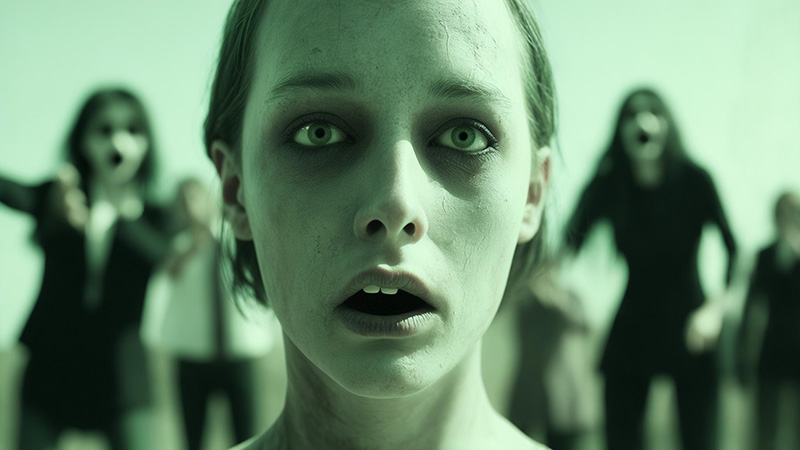
The premise is deceptively simple and profoundly terrifying. An unnamed Father (Christos Stergioglou) and Mother (Michele Valley) raise their three grown children — the Older Daughter (Aggeliki Papoulia), the Son (Hristos Passalis), and the Younger Daughter (Mary Tsoni) — inside a spacious villa surrounded by a tall fence. None of the children have ever left the property. They are told that airplanes flying overhead are toys that sometimes fall into the garden, that cats are murderous predators, and that the sea is a leather armchair. The parents have systematically rebuilt the Greek language itself: a "zombie" is a small yellow flower, a "telephone" is a salt shaker, an "excursion" is a strong flooring material. This meticulous linguistic sabotage is Lanthimos's most chilling invention. By controlling vocabulary, the Father does not merely restrict movement — he eliminates the very capacity for independent thought. The children cannot desire escape because they literally lack the words to imagine it.
The Outsider, the VHS Tapes, and the Crack in the Wall
The fragile ecosystem ruptures when the Father brings Christina (Anna Kalaitzidou), a security guard from his factory, into the house to satisfy his son's sexual urges — a transactional arrangement he treats with the same clinical detachment he applies to every household rule. Christina, however, is uncontrollable. She barters with the Older Daughter, exchanging forbidden VHS copies of Rocky IV and Jaws for sexual favors. These Hollywood tapes become the most dangerous contraband imaginable — not because of their content, but because they prove that an entire universe of narrative, emotion, and language exists beyond the fence. The Older Daughter begins quoting Rocky and Jaws like scripture, absorbing their dialogue as sacred texts from a world she has never been permitted to know. Lanthimos stages this contamination with surgical precision: the more the daughter consumes, the more the Father's fabricated reality frays at the edges.
Cinematic Language: How Lanthimos Weaponizes the Frame
What elevates Dogtooth from provocative concept to genuine masterwork is the formal rigor of its execution. Cinematographer Thimios Bakatakis — who would go on to shoot The Lobster and The Killing of a Sacred Deer — deploys a visual strategy of deliberate mutilation. Characters are routinely decapitated by the frame, their heads cut off at the forehead or chin, their bodies shown only from the waist down. This is not careless composition; it is a visual analogy for the psychological amputation the parents inflict on their children. The audience is denied full access to faces just as the children are denied full access to reality. Every static wide shot of the sun-bleached garden, the turquoise swimming pool, and the sterile living room radiates a sinister domesticity — paradise as penitentiary.
Performance as Behavioral Study
Lanthimos's direction of actors is famously unconventional, and Dogtooth is where this methodology crystallized. He instructed his cast to deliver lines in a flat, affectless monotone, stripping all conventional emotional signaling from their performances. Aggeliki Papoulia navigates scenes of violence, sexuality, and desperate yearning with the same blank expression, forcing the audience to project meaning onto her blankness. Christos Stergioglou plays the Father not as a ranting tyrant but as a soft-spoken bureaucrat of cruelty — a man who schedules abuse the way others schedule dentist appointments. This deadpan approach transforms every mundane family interaction into an exercise in existential dread, a performance style critics have compared to the clinical detachment of Michael Haneke, but with a uniquely absurdist Greek twist owing as much to the Theatre of the Absurd as to European art cinema.
💎 Verified Fact: Dogtooth was produced on a budget of approximately €250,000 — a €200,000 grant from the Greek Film Center plus €50,000 from the production company, Boo Productions, an Athens advertising agency making its very first feature film. Much of the crew worked as unpaid volunteers. The script took two full years to write, rehearsals lasted six weeks, and principal photography was completed in roughly one month during August 2008. When the film won at Cannes and received its Oscar nomination, Greek Prime Minister George Papandreou publicly declared that the achievement "went beyond cinema and concerned the entire country."
Legacy: The Birth of the Greek Weird Wave
Dogtooth did not merely launch a career — it ignited an entire cinematic movement. The film is universally recognized as the founding text of the Greek Weird Wave, a loose collective of filmmakers including Athina Rachel Tsangari (Attenberg) and Alexandros Avranas (Miss Violence), who emerged from the economic crisis of Greece to produce some of the most challenging and original European cinema of the 21st century.
For Lanthimos, Dogtooth established every thematic preoccupation he would continue to mine across his career. The Older Daughter smashing out her own canine tooth with a dumbbell to fulfill her father's rule that she may leave the compound only after losing a "dogtooth" remains one of the most visceral and symbolically loaded images in modern cinema — a literalization of the cost of freedom under totalitarian rule.
Frequently Asked Questions About Dogtooth (2009)
What is Dogtooth (2009) about?
Dogtooth follows three siblings raised in total isolation by controlling parents who manipulate reality, language, and perception to maintain absolute authority over their children.
Why is Dogtooth considered disturbing?
The film creates discomfort through emotional detachment, absurd control, and the normalization of psychological abuse within a sterile and controlled environment.
What does the title Dogtooth mean?
The “dogtooth” symbolizes a fabricated milestone — the parents claim their children can leave only once it falls out, reinforcing the illusion used to imprison them.
Why is language so important in the film?
The parents redefine basic words to control perception, proving that language itself can be weaponized to reshape reality and suppress independent thought.
Is Dogtooth based on real events?
No, but it functions as an allegory for authoritarian systems and extreme parental control, exaggerating reality to expose underlying psychological truths.
What is the meaning of the ending?
The ending leaves ambiguity — suggesting escape may be possible, but also questioning whether someone raised in total control can truly function outside it.