
The Architecture of Paranoia
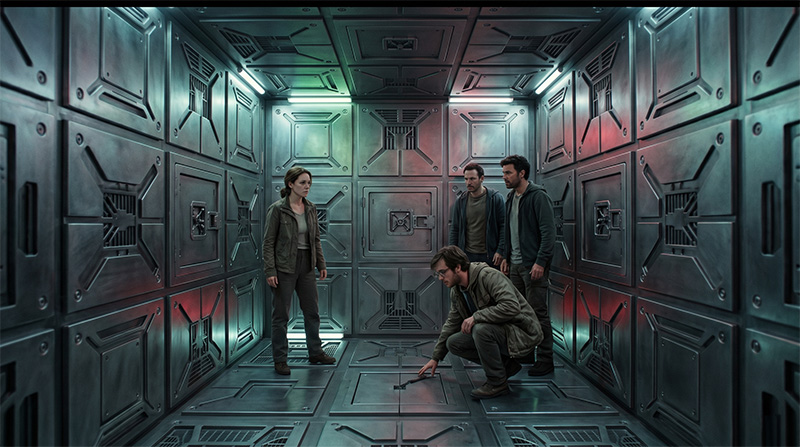
Vincenzo Natali’s Cube (1997) is a masterclass in minimalist horror. By confining six complete strangers inside an endless lattice of identical cubic rooms — some of which are equipped with sadistic mechanical traps — the film transforms geometry itself into an instrument of terror. There is no outside world, no grand conspiracy revealed, no comforting explanation. Only the cold, indifferent logic of the Cube and the rapidly deteriorating psychology of those trapped inside it.
Made on an astonishingly low budget of roughly $350,000 CAD, Natali shot the entire film on a single 14-foot set. Through clever use of colored lighting gels, repainting, and strategic camera angles, the production created the convincing illusion of hundreds of unique chambers. This extreme limitation became the film’s greatest strength: the claustrophobia is genuine, the performances raw, and the sense of inescapable dread overwhelming.
Mathematics as Horror
What separates Cube from most genre films is its intellectual rigor. The deadly traps are not random. Each room is marked with a numerical code that follows a consistent mathematical rule based on prime factorization. The characters — a mathematician, a doctor, an escape artist, a cop, an architect, and a mentally disabled man — must decode this system if they hope to survive. The film respects the intelligence of its audience by making the puzzle solvable for those paying close attention.
Yet the true horror of Cube is not the traps themselves. It is what confinement and fear do to human beings. As resources dwindle and pressure mounts, the group turns on itself far more effectively than any mechanical device. The Cube does not hate them. It simply exists — indifferent, mathematical, and absolute. This nihilistic precision is what makes the film linger long after the credits roll.
Natali’s Vision and Legacy
Cube was Natali’s feature debut, and it announced a singular directorial voice obsessed with systems that trap and dehumanize. His later works — Splice, Cypher, and In the Tall Grass — continue this fascination with spaces and rules that break the human spirit. While two sequels and a Japanese remake followed, none captured the austere brilliance and philosophical clarity of the original.
💎 Verified Fact: The entire film was shot on one modular 14-foot cube set in just 20 days. Natali has said the concept came from a childhood nightmare about being trapped inside a building that had no reason to exist. The production used different colored lighting gels and repainted the walls between setups to create the illusion of hundreds of unique rooms — a masterclass in resourceful filmmaking that turned extreme budgetary limitation into pure cinematic genius.
Frequently Asked Questions About Cube (1997)
What is Cube (1997) about?
Cube (1997) is a sci-fi psychological thriller about a group of strangers trapped inside a massive cube-shaped structure filled with deadly traps, forcing them to navigate logic, fear, and human conflict to survive.
What does the cube represent in Cube (1997)?
The cube is often interpreted as a metaphor for bureaucratic systems, existential entrapment, and the meaningless complexity of modern structures, where no one truly understands who built it or why.
Is Cube (1997) more about puzzles or psychology?
While the film includes mathematical and logical puzzles, its core focus is psychological — exploring trust, paranoia, leadership, and how people behave under extreme pressure.
Why is Cube (1997) considered a cult classic?
Cube gained cult status due to its minimalist setting, high-concept premise, and philosophical undertones, proving that tension and depth can be achieved without large budgets or traditional spectacle.
Who directed Cube (1997)?
Cube was directed by Vincenzo Natali, marking his feature debut and establishing him as a filmmaker skilled in high-concept, psychologically driven storytelling.