
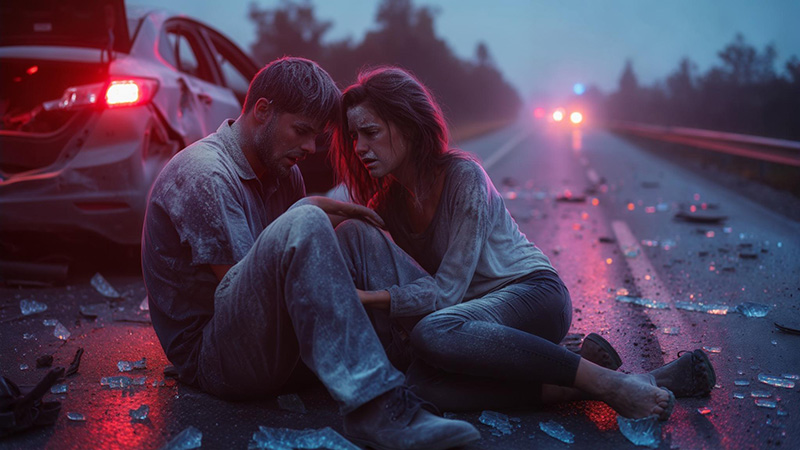
The Erotic Geometry of the Car Crash
David Cronenberg’s Crash (1996) stands as one of the most intellectually provocative and emotionally detached films ever made. Adapted from J.G. Ballard’s 1973 novel, it presents a world in which the boundary between human flesh and industrial technology has completely dissolved. The car is no longer a machine — it is an extension of sexual desire, a catalyst for transformation, and a site of both death and erotic rebirth.
James Spader delivers a performance of clinical detachment as James Ballard, a man who, after surviving a devastating collision, discovers that his previous life of sterile modernity has been replaced by an all-consuming obsession with the wounds, scars, and wreckage left by high-speed impacts. Guided by the charismatic and dangerous Vaughan (Elias Koteas), he enters a subculture that treats automobile accidents as both ritual and aphrodisiac.
Cronenberg’s Coldest Vision
What makes Crash so disturbing is not graphic violence, but its absolute emotional distance. Cronenberg films the most intimate acts with the same clinical precision he applies to twisted metal and scarred bodies. Peter Suschitzky’s cinematography turns mangled cars into sculptural objects of perverse beauty. There is no moral judgment, no catharsis — only the relentless, mechanical logic of desire meeting technology.
The film explores symphorophilia — sexual arousal derived from disasters — not as a freakish abnormality, but as the logical endpoint of modern consumer culture. In Cronenberg’s world, the car crash becomes the ultimate orgasm of the machine age. Holly Hunter, Deborah Kara Unger, and Rosanna Arquette deliver equally fearless performances, each surrendering to the film’s icy, hypnotic logic.
💎 Verified Fact: At the 1996 Cannes Film Festival, the jury — deeply divided — awarded Crash a Special Jury Prize “for originality, for daring, and for audacity.” Jury president Francis Ford Coppola reportedly fought against giving it the Palme d’Or. In North America, Ted Turner, head of Fine Line Features, personally tried to suppress the film’s release, describing it as “the most depraved film I’ve ever seen.” Despite (or because of) the controversy, Crash remains one of the purest and most uncompromising works in Cronenberg’s filmography.
Why Crash Still Matters
Almost thirty years later, the film feels more relevant than ever. As humanity becomes increasingly fused with technology — from smartphones to autonomous vehicles — Cronenberg’s vision of desire mediated through machines reads less like science fiction and more like prophecy. It remains a cold, brilliant, and deeply unsettling masterpiece that refuses to comfort its audience.
Frequently Asked Questions About Crash (1996)
What is Crash (1996) about?
Crash (1996) is a controversial psychological drama about individuals who develop a sexual fascination with car crashes, exploring the intersection of technology, desire, and the human body.
Why was Crash (1996) so controversial?
The film sparked major controversy due to its explicit depiction of sexuality linked to violence and machinery, leading to censorship debates and bans in several countries.
Is Crash (1996) based on a book?
Yes. Crash is based on the novel by J.G. Ballard, which explores similar themes of modern alienation, technological obsession, and the eroticization of trauma.
What themes define Crash (1996)?
The film explores themes of technological fetishism, emotional detachment, bodily transformation, and the merging of human identity with machines in a cold, clinical world.
Who directed Crash (1996)?
Crash was directed by David Cronenberg, known for his work in body horror and his exploration of the relationship between the human body and technology.