
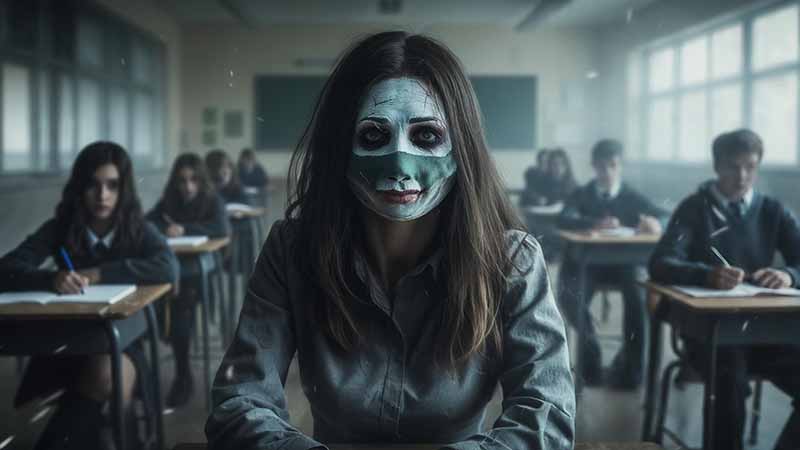
Confessions (2010): A Teacher's Calculus of Revenge
There is a moment, barely two minutes into Confessions (告白, 2010), where the camera holds on a carton of milk. Students laugh, chairs scrape, paper airplanes sail through the frame. The mundane chaos of a Japanese middle school classroom fills the screen with a deceptive ordinariness. Then Takako Matsu, in one of the most electrifying performances in 21st-century Asian cinema, begins to speak. Her voice is low, metronomic, devoid of emotion — the voice of a woman who has already crossed a line from which there is no return. By the time her opening monologue concludes, the milk will carry an entirely different meaning, the classroom will feel like a sealed tomb, and the audience will understand that director Tetsuya Nakashima has constructed something far more dangerous than a revenge thriller. He has built a moral labyrinth with no exit. As an archive dedicated to indexing the most significant works in world cinema, Sharing The Sickness provides an external player reference to this landmark Japanese film through an independent third-party platform.
Anatomy of a Perfect Revenge
Adapted from Kanae Minato's bestselling 2008 novel Kokuhaku, the film opens with teacher Yuko Moriguchi addressing her class on the last day before her resignation. Her four-year-old daughter Manami has drowned in the school pool. The police ruled it an accident. Yuko knows better. She has identified two students — referred to only as Student A and Student B — as the killers. Because Japan's Juvenile Law shields minors from criminal prosecution, the legal system offers her nothing. So Yuko constructs her own system of justice, one that operates not through violence but through information, manipulation, and the corrosive power of guilt. She announces to the entire class that she has laced the milk of the two murderers with HIV-positive blood drawn from Manami's dying father. Whether the claim is true becomes almost irrelevant; the psychological damage is instantaneous and absolute.
What elevates Confessions beyond its shocking premise is its narrative architecture. The story unfolds through a series of first-person testimonies — confessions, in the truest sense — delivered by Yuko, Student A (Shuya Watanabe, played by Yukito Nishii), Student B (Naoki Shimomura, played by Kaoru Fujiwara), Naoki's mother (Yoshino Kimura), idealistic replacement teacher Werther (Masaki Okada), and student Mizuki Kitahara (Ai Hashimoto). Each testimony reframes the truth, peeling back layers of motivation, self-deception, and moral collapse. Nakashima refuses to grant any single narrator the authority of objectivity. The audience is left to triangulate reality from a chorus of unreliable voices.
Nakashima's Visual Symphony of Dread
Tetsuya Nakashima came to feature filmmaking from a celebrated career in Japanese advertising, and that background pulses through every frame. Confessions is one of the most visually audacious films of the past two decades — a work that operates on a sensory frequency closer to music than to conventional cinema. Slow-motion sequences stretch single moments into agonizing eternities. Rain cascades in hyper-stylized sheets against desaturated blues and clinical grays. Explosions of color erupt without warning, shattering the palette as violently as the characters shatter each other's lives. The cinematography by Shouichi Atou and Atsushi Ozawa deploys an arsenal of techniques — tilt-shift miniaturization, overhead God's-eye compositions, extreme close-ups on trembling hands — that transform a school building into an expressionist nightmare.
The soundtrack operates as a parallel narrative. Nakashima's decision to layer Radiohead's Last Flowers, Boris's wall-of-noise guitars, and fragments of Bach's Concerto No. 5 in F Minor over scenes of adolescent cruelty creates a dissonance that is almost physically uncomfortable. The music does not underscore emotion; it contradicts it, pairing beauty with horror in ways that leave viewers unable to settle into the safety of a single feeling. This is deliberate. Nakashima does not want comfort. He wants complicity.
The Broken Machinery of Youth
Beneath its revenge architecture, Confessions is a devastating autopsy of the Japanese education system and, by extension, of any society that treats children as raw material to be molded rather than as complex moral agents. Student A is a prodigy who murders to prove his intellectual superiority, desperate for recognition from an absent mother who abandoned him to pursue her own academic career. Student B is a fragile, bullied boy who kills almost by accident, driven by a pathological need for acceptance. Their homeroom teacher Werther is a well-meaning idealist whose progressive philosophy of compassion and rehabilitation becomes a weapon that the students wield against him. Naoki's mother smothers her son with a love so suffocating it becomes its own form of violence. Every adult in the film fails the children in a different way, and every child absorbs that failure and transforms it into destruction.
Nakashima does not moralize. He presents. The film's recurring verbal refrain — "nante ne" (just kidding) — punctuates moments of devastating sincerity with a casual cruelty that mirrors the way teenagers weaponize irony to avoid confronting the weight of their own actions. It is a phrase that echoes long after the credits roll, a three-syllable encapsulation of an entire generation's inability to reckon with consequences.
💎 Cinematic Diamond: The Actress Who Made the Film Possible
Did you know? Director Tetsuya Nakashima publicly stated that Confessions would not exist without Takako Matsu. He refused to make the film with any other actress in the lead. Matsu — the daughter of legendary kabuki actor Matsumoto Hakuō II — was at the peak of her career as one of Japan's most respected dramatic actresses, and Nakashima wrote the screenplay specifically around her capacity to convey devastating emotional violence through stillness and restraint. Additionally, the production held an audition that drew over 1,000 young applicants for the student roles; only 34 were selected. Among them was Ai Hashimoto, who was just 13 years old and making her film debut as Mizuki — a performance so striking that it launched her into one of the most prolific careers in contemporary Japanese cinema. The film grossed over ¥3.85 billion ($45.2 million worldwide), became Japan's official submission for the 83rd Academy Awards, and was shortlisted for Best Foreign Language Film — a remarkable achievement for a movie whose themes were considered too dark for mainstream Western distribution.
A Masterwork That Redefines the Revenge Genre
Confessions swept Japan's most prestigious film awards in 2011, capturing Best Picture, Best Director, Best Screenplay, and Best Editor at the 34th Japan Academy Prize, along with Best Picture at the 53rd Blue Ribbon Awards and Best Asian Film at the 30th Hong Kong Film Awards. Its critical and commercial triumph confirmed what audiences already sensed: this was not merely a thriller but a cultural event, a film that crystallized anxieties about youth violence, educational failure, and moral responsibility into 106 minutes of relentless, hypnotic cinema. Nakashima's refusal to provide easy answers — his insistence that revenge is neither heroic nor cathartic but merely another form of destruction — places Confessions in the company of the greatest morally ambiguous films ever made.
For those seeking cinema that refuses to simplify, that demands intellectual engagement while delivering visceral impact, Confessions is an essential experience. By providing an external player reference to the film, Sharing The Sickness ensures that this extraordinary work of Japanese cinema remains accessible to discerning audiences worldwide. This is a film that does not ask whether revenge is justified. It asks something far more unsettling: what remains of the avenger after the revenge is complete?
Frequently Asked Questions About Confessions (2010)
Where can I access Confessions (2010)?
Sharing The Sickness provides an external player reference for this title through an independent third-party platform. We do not host or store media files on this page.
What is Confessions (2010) about?
Confessions (2010) follows a middle school teacher who reveals a shocking truth to her students and sets in motion a calculated psychological revenge, exposing the darkness beneath youth and innocence.
Why is Confessions (2010) considered disturbing?
Confessions (2010) is considered disturbing due to its cold, methodical exploration of revenge, emotional cruelty, and the collapse of morality within a school environment, presented through fragmented storytelling and intense psychological tension.
Who directed Confessions (2010)?
Confessions (2010) was directed by Tetsuya Nakashima.
Was Confessions (2010) controversial or restricted?
Confessions (2010) was not widely banned but gained attention for its dark themes involving youth violence and revenge, receiving restrictive classifications in some regions due to its psychological intensity.