
Dance as Ecstasy, Dance as Collapse: The Method of Climax
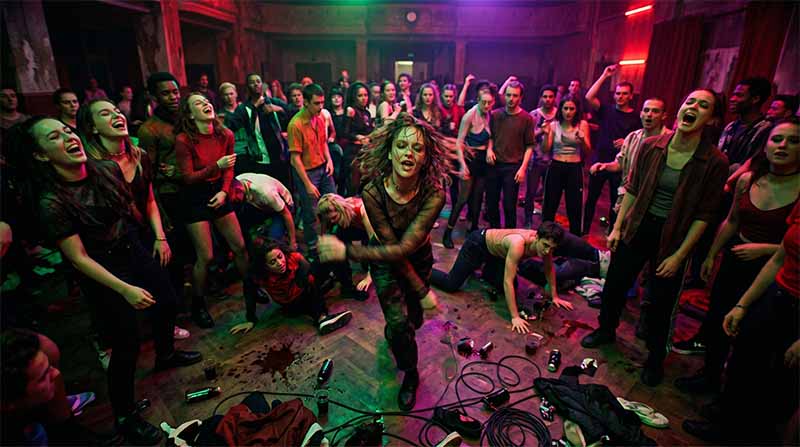
Gaspar Noé made Climax in fifteen days with fewer than twenty crew members in a single location — a disused sports hall outside Paris. The conditions were, by design, intense: the cast lived together in the building throughout the shoot, the film was photographed entirely in chronological sequence, and the dancers — most of them professional performers rather than trained film actors — were given minimal conventional direction during the drugged sequences. What Noé asked of them instead was simpler and more demanding: be terrifying. The result is a film that feels less directed than unleashed, a document of collective performance under extreme conditions that bears a closer relationship to installation art than to conventional narrative cinema.
The film's structure is as formally deliberate as its production was spontaneous. Climax opens with end credits — a bold declaration that narrative closure is not its primary concern — and then delivers an extended interview sequence in which each dancer speaks directly to camera, establishing individual personalities and relationships with the precision of a naturalist preparing specimens for observation. Then comes the opening dance sequence: nine minutes of extraordinary choreography, shot in a single continuous take by cinematographer Benoît Debie, that establishes the company's collective excellence and the stakes of what the second half will destroy.
Benoît Debie's Camera and the Grammar of Psychedelic Dissolution
Debie is one of contemporary cinema's essential cinematographers — his work with Noé on Irréversible and Enter the Void established a visual vocabulary for extremity that few DPs have approached. In Climax, he operates the camera himself throughout, and the physical relationship between operator and image becomes increasingly intimate and unstable as the LSD takes hold. The film's most extreme sequences involve rotating the camera on its vertical axis, turning the image ninety degrees, a hundred and eighty degrees, until the floor becomes ceiling and the architecture of the building becomes a funhouse mirror of its former self.
This is not aesthetic indulgence. The camera's disorientation tracks the characters' neurological state with documentary precision. Noé and Debie understand that the horror of an involuntary drug experience is not the content of the hallucinations but the loss of spatial and temporal orientation — the collapse of the reliable framework through which we process reality. By the film's final thirty minutes, the camera has become as unreliable as the characters' own perceptions, and the viewer has no stable position from which to observe. The sickness is total. The film has done what it announced in its opening frames it would do.
The Soundtrack as Architecture: Daft Punk, Aphex Twin, Cerrone
Noé constructed the film's soundtrack — featuring tracks by Daft Punk, Aphex Twin, Cerrone, Gary Numan, and Kiddy Smile among others — as a parallel structure that operates independently of the visual narrative while remaining inseparable from it. The music does not score the action in the conventional sense; it drives it, determines its tempo, and ultimately outlasts it. In the film's final sequences, the soundtrack continues at full volume over images that have become almost abstract — bodies in darkness, fragments of movement, light without context. The music is the last coherent system still functioning after everything else has collapsed.
This formal decision — the soundtrack as the film's most stable element — reflects Noé's understanding of what the dancers experience. For professional performers, music is the primary architecture of reality; choreography is built around it, identity is organized through it. When everything else the characters know dissolves under the drug's influence, the music continues. It is simultaneously comfort and torment, the last familiar thing in an environment that has become entirely hostile.
💎 Verified Fact: Noé conceived and shot Climax in fifteen days with a budget he has described as approximately €3 million — extraordinarily low for a film that premiered in the Directors' Fortnight at Cannes and received international distribution. The film's opening title cards — "This is a French film. It is a proud and joyful achievement" — were added after the shoot as a direct response to the French film establishment's initial skepticism about the project. The entire production was funded without involvement from the Centre national du cinéma, the French government body that funds most French films. Noé financed it through sales of international rights before a single frame was shot, a structuring decision that gave him total creative freedom and no institutional oversight whatsoever.
Frequently Asked Questions About Climax (2018)
Is Climax (2018) based on a true story?
Partially. The film was inspired by real accounts of a dance troupe allegedly drugged during a party, which Gaspar Noé expanded into a stylized descent into chaos.
Why does Climax feel so real and chaotic?
The film uses long unbroken takes, improvisation, and a cast of real dancers instead of actors, creating a raw, documentary-like intensity.
What is Climax actually about beyond the party setting?
At its core, the film explores collective breakdown, loss of control, and how quickly social order collapses under psychological pressure.
What makes the cinematography of Climax unique?
The camera moves fluidly and often inverts orientation, visually mirroring the characters’ mental disorientation and the descent into madness.
Why is Climax considered a standout in modern extreme cinema?
Its combination of dance, music, and psychological horror—without relying on traditional plot—creates a visceral, immersive experience unlike typical narrative films.