
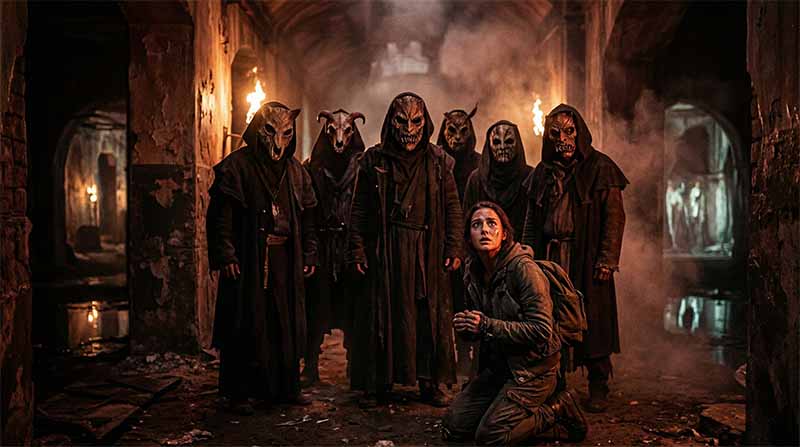
Through the Gate: How Baskin Redefined Turkish Horror Cinema
When first-time feature director Can Evrenol unleashed Baskin upon audiences at the 2015 Toronto International Film Festival, the global horror community was forced to recalibrate its expectations of what Turkish cinema could deliver. Born from Evrenol's visceral 2013 short film of the same name, the feature-length Baskin is a relentless, hallucinatory plunge into surrealist terror that owes as much to the baroque nightmares of Lucio Fulci and Clive Barker as it does to deeply rooted Anatolian folklore. Produced on a micro-budget of approximately $350,000, the film defied every financial limitation placed upon it, delivering imagery so uncompromisingly horrific and atmospherically dense that it instantly earned comparisons to the greatest works of Italian giallo and cosmic horror.
The Architecture of a Nightmare
What separates Baskin from conventional horror fare is its absolute commitment to non-linear, dreamlike storytelling. The film opens with a disorienting childhood vision — young Arda witnesses something unspeakable behind a door — before cutting to a grimy roadside diner where five Turkish police officers share crude jokes and raw masculine bravado over bowls of stew. These men are not heroes. They are flawed, vulgar, and profoundly human, which makes the horrors awaiting them exponentially more devastating. When the squad responds to a backup call from the remote village of Inceagac, Evrenol masterfully tightens the atmospheric screws. Cinematographer Alp Korfali shot the entire production over twenty-eight consecutive nights in Istanbul, with not a single frame captured during daylight. This decision saturates every image with an oppressive, claustrophobic darkness that becomes its own character — a suffocating void from which neither the officers nor the audience can escape.
The Father: A Villain Forged in Reality
At the black heart of Baskin sits one of the most unforgettable antagonists in modern horror: The Father, played by Mehmet Cerrahoğlu. The Father is the self-proclaimed shepherd of a demonic cult that has transformed the abandoned building into a literal gateway to Hell. Cerrahoğlu delivers a performance of terrifying serenity — a soft-spoken philosopher of pain who welcomes the doomed officers into his domain with the calm assurance of a priest receiving his congregation. His monologues about the nature of flesh, suffering, and transcendence are delivered with such quiet conviction that they burrow under the skin far more effectively than any scream or jump scare ever could. Evrenol instructed Cerrahoğlu to study Coppola's Apocalypse Now alongside Hellraiser and A Nightmare on Elm Street, to craft a villain who embodies cosmic authority rather than conventional menace. The result is a figure who feels genuinely otherworldly — a gatekeeper between dimensions who has existed long before his victims arrived and will persist long after they are consumed.
Folklore, Fractured Time, and the Eternal Cycle
Beneath its Grand Guignol surface, Baskin operates on a deeply symbolic level rooted in Turkish folklore. The film's alternative Turkish title, Karabasan, refers to a sleep paralysis demon from Anatolian mythology — a malevolent entity that visits people in the night, pressing down on their chests and trapping them in a state between waking and dreaming. This concept is woven into the very fabric of the narrative structure. As the officers descend deeper into the cult's domain, the boundaries between memory, dream, and reality dissolve entirely. Flashbacks to Arda's childhood trauma begin overlapping with present-moment horrors. Sequences repeat with subtle variations. The climax does not resolve the narrative so much as fold it back upon itself, revealing that the officers may have always been trapped in this loop — that their arrival at Inceagac was not an accident but a predestined return.
Crafting Hell on a Micro-Budget
The practical effects work in Baskin is astonishing when considered against its $350,000 budget. Evrenol and his production team constructed the cult's lair as an elaborate practical set, filling it with viscera, chains, mutilated figures, and ritualistic staging that recalls the tortured canvases of Hieronymus Bosch and Francis Bacon. Unlike many contemporary horror films that lean on digital shortcuts, Baskin achieves its most disturbing imagery through tangible, in-camera effects. The textures are real. The blood is wet. This commitment to practical craft gives the cult sequences a nauseating immediacy that CGI cannot replicate. The film's sound design and score by Ulas Pakkan and Volkan Akaalp further amplify the dread, blending industrial drones, distorted folk melodies, and a haunting rendition of the Turkish classic Dere Boyu Kavaklar that transforms a nostalgic love song into an anthem of impending doom.
💎 Verified Fact: Mehmet Cerrahoğlu, who plays The Father, was not wearing prosthetic makeup or special effects of any kind. Cerrahoğlu lives with an extremely rare genetic condition called GAPO syndrome — a disorder so uncommon that fewer than 40 cases have ever been documented in medical literature worldwide. The condition affects hair growth, skeletal structure, and skin elasticity. Before Baskin, Cerrahoğlu had never acted professionally. Evrenol discovered him and spent weeks preparing him for the part, having him study performances by Robert Englund in A Nightmare on Elm Street, Doug Bradley in Hellraiser, and Marlon Brando in Apocalypse Now. Cerrahoğlu's portrayal of The Father became the single most discussed element of the film, turning a first-time actor into one of the most iconic horror villains of the 2010s.
Frequently Asked Questions About Baskin (2015)
What is Baskin (2015) about?
Baskin follows a group of Turkish police officers who stumble upon a nightmarish location, descending into a surreal and violent underworld that feels closer to hell than reality.
Is Baskin based on Turkish folklore or mythology?
Yes — the film draws heavily from Islamic and Turkish interpretations of hell, blending religious imagery with surreal horror to create a uniquely cultural vision of damnation.
Why does Baskin feel so surreal and disorienting?
The film abandons linear storytelling midway, shifting into dream logic where time, identity, and space collapse, reflecting a descent into psychological and spiritual chaos.
What makes Baskin different from Western horror films?
Unlike typical Western horror, Baskin focuses less on jump scares and more on atmosphere, ritualistic imagery, and existential dread rooted in cultural symbolism.
What is the meaning behind the ending of Baskin?
The ending suggests an inescapable cycle of suffering, where the protagonist may be trapped in a repeating nightmare or a metaphysical punishment beyond comprehension.