
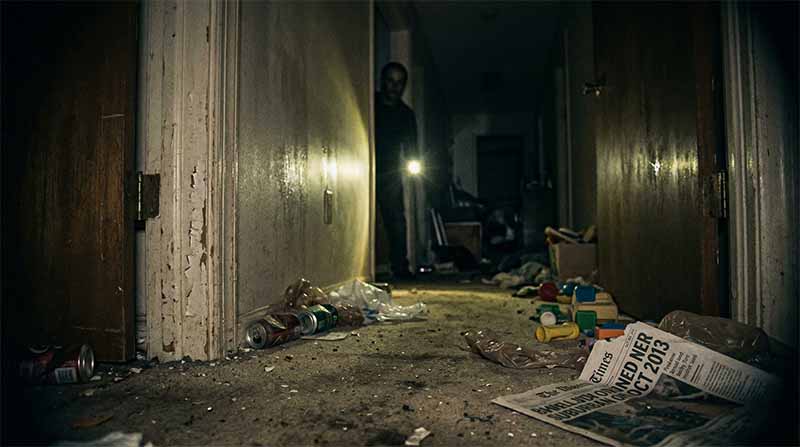
August Underground (2001) and the Refusal of Horror Comfort
August Underground survives in horror culture less as ordinary entertainment than as a contaminated object — the kind of film passed between viewers with a warning, a challenge, or an expression of disbelief. Directed by Fred Vogel and released in 2001, it emerged before found-footage aesthetics became fully commercialized, and that timing is central to its force. Rather than presenting supernatural mystery or a polished illusion of realism, Vogel pushes the form into something far meaner and more abrasive. The film is designed to feel not merely low-budget but anti-cinematic, as though its images should not have stabilized into a movie at all.
That is what makes it so different from most horror built around killers or recorded atrocities. The film does not heighten violence into narrative spectacle; it flattens it into routine. Acts of cruelty occur in ugly rooms, nameless streets, improvised hideouts, and mundane spaces that would carry no atmosphere in a conventional thriller. This deadened treatment is crucial. By refusing orchestration, the film creates a sensation that the worst thing about the violence is not its scale but its banality. Horror is no longer a set piece. It becomes behavior.
Why the Film Feels So Illicit
The aesthetic strategy of August Underground is the real engine of its notoriety. The unstable handheld image, consumer-grade video texture, ragged sound, and visual ugliness are not technical accidents that need excusing. They are the film’s method. Vogel understood that polish would weaken the sensation he was trying to produce. If the imagery looked composed, audiences could retreat into the safety of craft appreciation. By making the material look degraded and amateur, he narrows the distance between fiction and contamination. The viewer is encouraged to feel less like a spectator and more like someone who has found something that should not be circulating.
This is also why the film remains more disturbing to some viewers than far more expensive and graphically explicit horror films. Mainstream extremity often still carries a grammar of professionalism that reassures the viewer: framing is too elegant, pacing too controlled, sound design too deliberate. August Underground attacks that safety net. Its disorder becomes an atmosphere of moral infection. Nothing in the image promises that the film will eventually become legible, moral, or redemptive. It simply remains there, raw and hostile.
Fred Vogel and the Anti-Myth of the Serial Killer
Another important reason the film endures is that it strips serial violence of charisma. In many thrillers and horror films, the killer becomes a mythic figure — clever, stylish, psychologically elevated, or cinematically seductive. August Underground rejects that tradition. Its offenders are not icons; they are coarse, juvenile, sadistic, and spiritually rotten. The camera does not transform them into legends. It implicates them in endless stupidity and waste. That refusal is one of the film’s most intelligent decisions. It turns violence into decay rather than mythology.
Because of that, the film can be read as a reaction against the glamorous treatment of cruelty in genre cinema. It is not interested in forensic puzzles, criminal genius, or elegant depravity. It is interested in the ugliest possibility: that horror, stripped of style, is pathetic as well as monstrous. This creates a uniquely corrosive experience. Viewers are not simply frightened; they are denied the pleasures that usually accompany fear in cinema.
DIY Production, Toetag Pictures, and Underground Distribution
August Underground also matters as a landmark of underground production culture. Fred Vogel did not merely direct the film; he helped build its entire ecosystem through writing, performance, distribution, and identity formation around Toetag Pictures. That degree of authorship matters. The film feels singular because it was not shaped by committee logic or softened for broad accessibility. Its limitations were not hidden. They were converted into aesthetic force.
The film’s circulation history became part of its myth. In underground horror, the route a movie takes can matter almost as much as the images it contains. August Underground spread through mail-order culture, tape trading, and word-of-mouth notoriety, acquiring a reputation as something halfway between film artifact and forbidden evidence. That outlaw aura intensified when copies were treated with suspicion by customs authorities and moral gatekeepers, reinforcing the sense that the film existed on the wrong side of acceptable circulation.
Why August Underground Still Matters
Within the broader history of found-footage and exploitation horror, August Underground matters because it pushed realism toward a hostile extreme. It asked what would happen if horror stopped trying to entertain and instead tried to contaminate. That decision makes it divisive, unpleasant, and often resisted — but also historically significant. The film exposed how much of horror pleasure depends on cinematic structure, and what remains when that structure is deliberately vandalized.
Within Sharing The Sickness, the film belongs in the archive because it represents an important fracture point in extreme cinema: a work that abandoned polish, refused myth, and built its power from degraded image culture, anti-narrative drift, and moral corrosion. Whether one considers it unbearable, essential, or both, August Underground remains one of the clearest examples of underground horror attempting to become indistinguishable from damage itself.
💎 Verified Fact: The most radical thing about August Underground is not the gore but the removal of cinematic reward. Vogel denies the viewer style, rhythm, catharsis, and psychological glamour, turning the found-footage format into a machine for moral exhaustion. That is why the film lingers: it does not shock like a set piece, it degrades like an atmosphere.
Frequently Asked Questions About August Underground (2001)
What is August Underground (2001) about?
August Underground presents a raw, found-footage style portrayal of two individuals documenting extreme acts of violence, structured to feel like an unfiltered recording rather than a traditional narrative film.
Is August Underground a real film or actual footage?
It is a fictional film, but deliberately shot to resemble real amateur footage. Its realism and lack of cinematic structure are designed to blur the line between staged horror and perceived reality.
Why is August Underground considered one of the most extreme films ever made?
The film avoids storytelling conventions and instead focuses on sustained realism, minimal editing, and raw presentation, making it feel more like documentation than entertainment.
Was August Underground banned or censored?
The film has faced legal scrutiny and seizures in multiple countries due to its extreme content and realistic presentation, often being mistaken for actual criminal footage.
What makes August Underground important in underground cinema?
It became a defining entry in underground extreme cinema for pushing realism to its limits, influencing later shock-based and pseudo-snuff style productions.