
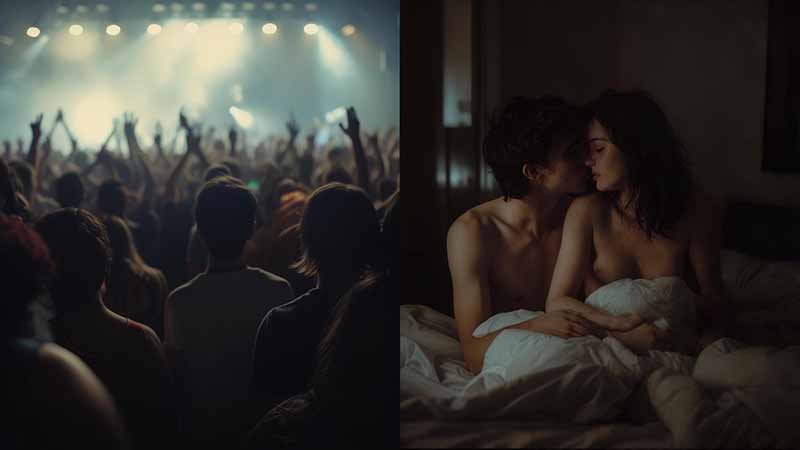
Music as the Architecture of Desire
Michael Winterbottom made 9 Songs in 2004 with a crew of five people, a budget that the director has described as negligible, and a creative proposition so simple it required almost no justification: two people, nine concerts, everything in between. The film runs 69 minutes. It contains no plot in the conventional sense, no character arcs, no narrative resolution. What it contains is the documentation of a love affair in the only two registers that Winterbottom deemed honest enough to record — live music and unsimulated sex.
The structural conceit is precise. The nine concert sequences — filmed at actual live events including Brixton Academy performances by Franz Ferdinand, Primal Scream, Black Rebel Motorcycle Club, and Elbow, plus Goldfrapp and Michael Nyman at Somerset House — were not staged for the film. They are real concerts, attended by real audiences, photographed without special access. Matt (Kieran O'Brien) and Lisa (Margo Stilley) move through them as civilians. Between the concerts, they return to a flat. What happens in the flat is not performed. This formal consistency — the actual and the intimate treated with identical directorial regard — is the film's central argument.
The BBFC Decision and Its Consequences for British Cinema
When 9 Songs was submitted to the British Board of Film Classification in 2004, the Board faced a question with no clear precedent in its recent history: what to do with a film containing explicit unsimulated sexual acts made by a recognized British director within the mainstream production infrastructure? The BBFC's decision to pass the film uncut with an 18 certificate was widely regarded as a landmark moment in British classification history. The Board's reasoning — that the explicit content served a legitimate artistic purpose and that the film did not cross into what it classified as pornography — effectively established a new precedent for what was permissible in theatrical releases distributed by mainstream companies.
The international reception was considerably less permissive. In the United States the film received an NC-17 rating, the designation that effectively prevents mainstream theatrical distribution. In various European and Asian territories it received restrictive certifications or was declined theatrical release entirely. The film was produced with an 18 certificate in mind from the outset — Winterbottom has stated in interviews that he was in close communication with the BBFC during production — but the gap between British and international responses revealed the extent to which different regulatory cultures draw different lines around the same material.
Winterbottom's Documentary Method Applied to Intimacy
Winterbottom is one of British cinema's most formally restless directors — a filmmaker who has made prison dramas, Westerns, road movies, comedies, and documentary-fiction hybrids across a career that resists any single characterization. 9 Songs is the logical terminus of his documentary methodology applied to the most private form of human activity. The camera that recorded Franz Ferdinand at Brixton Academy — handheld, immediate, present — is the same camera that recorded Stilley and O'Brien in the flat. No special accommodation is made. No softening is applied. The film treats intimate life as public life, and public life as intimate, without distinguishing between the two.
O'Brien has spoken in interviews about the experience with a directness that mirrors the film itself — describing the shoots as genuinely unusual and occasionally uncomfortable but consistent with what Winterbottom had clearly articulated as his artistic intent from the beginning. Stilley was less forthcoming publicly, and the film's reception affected her professional trajectory in ways that were not universally welcome. These are the human costs of a formal decision made in the abstract, and they are part of the film's permanent record as much as the images themselves.
★ THE DIAMOND TIP: The BBFC's Precedent-Setting Decision
💎 Verified Fact: The nine concerts in 9 Songs were actual unscripted live events shot with a minimal handheld crew on real audience nights. The film's BBFC submission was so unusual that the Board invited Winterbottom to discuss the film before issuing its classification decision — an exceptional procedure reserved for films that require special consideration. The Board ultimately issued an uncut 18 certificate with a formal statement explaining its reasoning, which was subsequently quoted extensively in academic and legal discussions about the boundaries of artistic freedom and obscenity in British film regulation. The BBFC's written justification for the 9 Songs classification is now cited in British film law courses as the primary document establishing the distinction between "explicit artistic work" and "pornographic content" in the post-2000 regulatory framework.
Frequently Asked Questions About 9 Songs (2004)
Where can I access 9 Songs (2004)?
Sharing The Sickness provides an external player reference for this title through an independent third-party platform. We do not host or store media files on this page.
What is 9 Songs (2004) about?
9 Songs (2004) chronicles a brief and intense relationship between two young people in London, structured around a series of live music concerts and intimate encounters that blur memory, desire, and emotional detachment.
Why is 9 Songs (2004) considered controversial?
9 Songs (2004) became highly controversial due to its use of unsimulated sexual scenes combined with a minimalist narrative, challenging conventional boundaries between art-house cinema and explicit realism.
Who directed 9 Songs (2004)?
9 Songs (2004) was directed by Michael Winterbottom.
Was 9 Songs (2004) censored or restricted?
9 Songs (2004) faced censorship and strict classification in several countries due to its explicit content, with some versions cut while others were released uncut in art-house contexts.